Showing posts with label audubon. Show all posts

Monday, August 13, 2018

Gila woodpeckers in Arizona

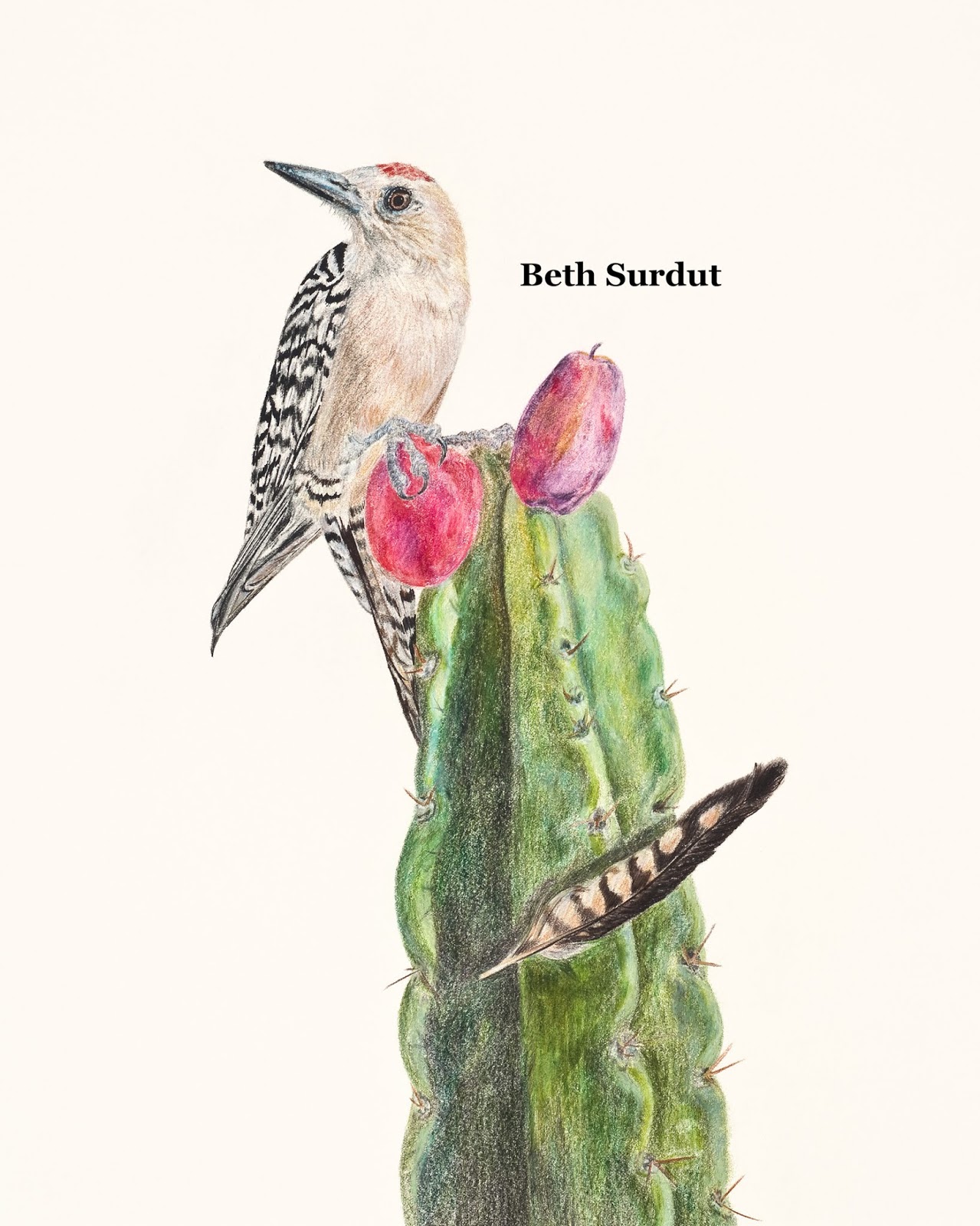
Inspector Gila was busy this morning, negotiating the barrel cactus in front of my desk. The male woodpeckers sport what looks like a red lipstick streak on their heads. Their voices, clearly heard, even when competing with traffic noise, sound like squeak toys having a party.
Learn about our relationship and the amazing engineering of these birds at https://news.azpm.org/…/122294-the-art-of-paying-attention…/

photo: Beth Surdut

Some creatures negotiate the thorniness of life better than others.

 
photo: Beth Surdut

Gila Woodpecker claims a cactus fruit. Pencil and pen on paper-- drawing by Beth Surdut


Thursday, May 12, 2016

White-winged doves in the Southwest

Beth Surdut's The Art of Paying Attention: White-Winged Doves

 
Author and artist Beth Surdut listens to ravens, and has paddled with alligators in wild and scenic places. She also knows that a nest shouldn't be judged on appearance alone
Listen on NPR:
White-winged Doves
©Beth Surdut 2016
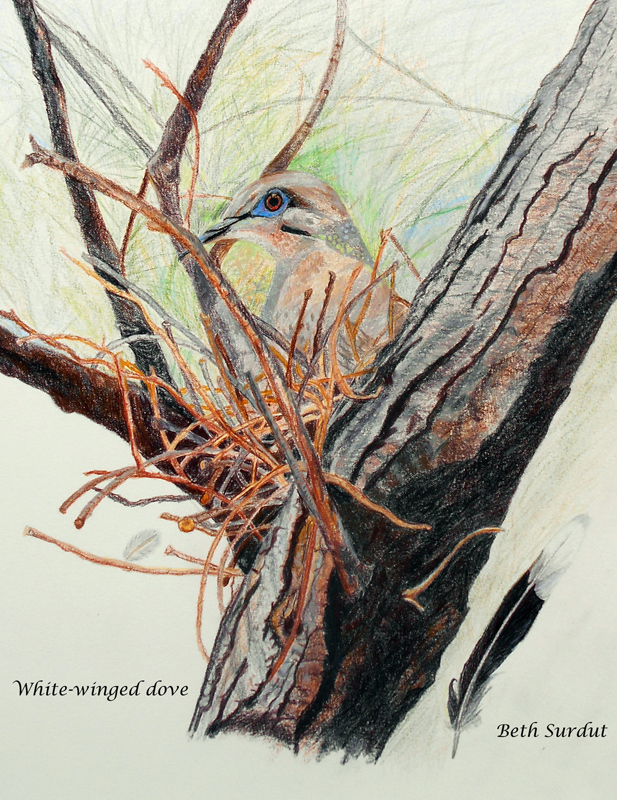
High-up in the imposing tamarisk tree outside my bedroom window, a migratory white-winged dove nestles like a plump teapot in the flat saucer where the branches fork. I can see the circle of blue highlighted with lavender around her bright orange eye as she bends her head to rearrange some sticks poking out around her. Her mate arrives with another slim stick in his beak and he stands on her back, drops the stick next to her, and then flies off for what seems to be a very long time before returning with another stick. Again, he stands on top of her, drops his gift, which slides away and shimmies through the air. He does not fly down to retrieve it, but instead returns to his favorite building supply area.
I think they must be new at this, but the more attention I pay, the more I learn that there is a lot that I don’t know about critters, even when I think I do.
By day two of construction, we have had rain—unusual, I’m told. The air sits sweet and sticky on my skin. The dove sits on her sticks. When hummingbirds build a nest, it is compact, dense, designed with tensile strength and lined with soft materials. Clearly, the doves didn’t get that memo. If these inhabitants were humans, they’d be on the road to divorce or looking for another architect and builder.
By day four, the nest looks like a skeleton ready to be filled in. Ms. Dove sits, but doesn’t stay. I take the opportunity to wrap my dressmaker’s tape around the tamarisk’s girth—41 inches tapering upwards to 36. I’m impressed. Though these trees are disliked for their lusty drinking habits and sloppy grooming, I see this one as a tree of life where not only the doves nest, but also, varieties of sparrows, hummingbirds, and verdins perch and call while collared lizards scuttle across the bulky outstretched base.
beth surdut dove unsized body image
Later in the morning, as I’m watering the nearby bamboo, the dove pair returns. She nestles, he stands on top of her, his head above hers, and their heads turn towards me in unison as I walk by. The unlined, seemingly rickety, open-air nest that resembles a tangled pile of the game of Pick-Up Sticks proves to be a challenge for me to draw as I try to discern where the elements intersect. What appeared to be a haphazard pile, serves the purpose of holding mother and two eggs—usually two—until little pin-feathered beings grow viable feathers and fly to the ground after two weeks. Both parents watch over them during incubation and through this exploratory period, but doves are food for the Harris’ and Cooper’s hawks in my ‘hood.
Yet even with the losses due to predation, consider the seemingly ubiquitous presence of doves that pollinate saguaros and line the utility wires — I often count more than 20 — and the ones that fly out of the oleanders and eucalyptus as if flushed by hounds when I walk by. Look around for the nests—my neighbor has one built on the electrical outlet cover next to the light by her front door, another in the rhus lancia tree at the corner of her house, and a third on a crossbeam under her patio roof.
Last year, at the edge of a gravel road that leads to my house, the doves chose a labyrinthine mass of cholla with pointy twists and turns surrounded by prickly pear that seemed to present a formidable fortress. Sometimes, if the mother deemed I was too close—she had, after all, chosen a well-trodden path--she would fly off and pretend she was wounded, dropping one white-tipped wing and dragging it as she hopped along on the ground, making herself an obvious target.
A friend came to visit, arriving at my front door, saying “There was a Harris’ hawk standing on the ground just as I made the turn into here. I wonder why?’
I knew why. When I got there, the mother and two babies--they were not old enough to fly—were gone, feathers scattered, some standing upright like little grave markers.
This month marks a year that I’ve lived here, and I see nests being reconstructed in many of the same places. The current babies fledged in that cholla today—the mother was on the nest, father on a branch near her, and I found one youngster walking on the ground below them. I looked up into the trees and the utility pole tops where I usually see the hawks, listened for their distinctive calls, but heard only the drone of bees, the chittering of small birds, and the calls of the white-winged doves.
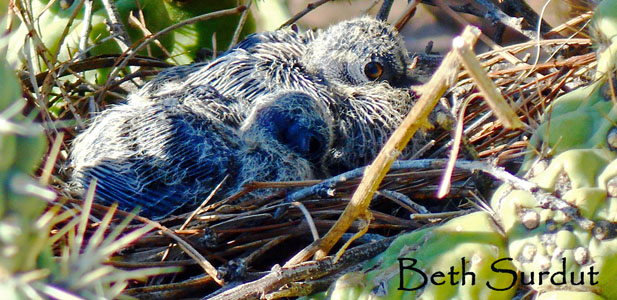
beth surdut baby dove nest photo unsized
The Art of Paying Attention Workshop
Observing nature starts with curiosity about what grows, flies, and crawls around you. Explore our integrated place in nature in a workshop with award-winning wildlife artist and writer Beth Surdut, creator of the illustrated Listening to Raven stories and The Art of Paying Attention NPR radio series.
Sponsored by Pima County and the USA National Phenology Network, for ages 12 and up.
Date & Time: Thursday, May 26, 2016 from 4:30 – 6:00 p.m.
Where: Pima County Agua Caliente Park, 12325 E. Roger Road
Cost: Free with park membership, non-member fee: $10. Pre-registration preferred..
Please bring a notebook!
For more information contact www.pima.gov/nrpr, eeducation@pima.gov, or call 520-615-7855
Visual storyteller Beth Surdut invites you to observe, with unbounded curiosity, the wild life that flies, crawls, and skitters along with us in our changing environment. From exotic orchids and poison dart frogs to local hawks and javelinas, Surdut illustrates her experiences with wild and cultivated nature by creating color-saturated silk paintings and detailed drawings accompanied by true stories.
You can find Surdut's drawings - and true stories about spirited critters - at listeningtoraven.com 
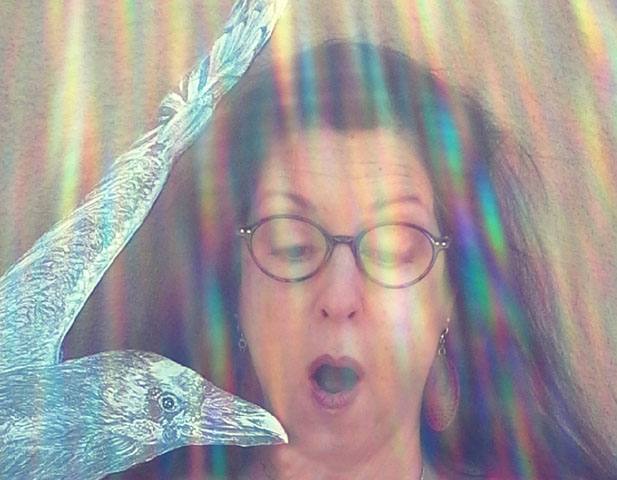
beth surdut with raven statue unsized
Beth Surdut's illustrated work Listening to Raven won the 2013 Tucson Festival of Books Literary Award for Non-Fiction. Elements of her raven clan have appeared in Orion Magazine, flown across the digitally looped Art Billboard Project in Albany, New York and roosted at the New York State Museum in an exhibition of international scientific illustrators.


Tuesday, May 10, 2016

Hummingbird Etiquette on NPR

The Art of Paying Attention: Hummingbird Etiquette
© Beth Surdut, 2016
Audio on NPR/Arizona Spotlight

This story starts with bird droppings. But before I go any further, if you have a penny and a quarter handy, please hold one of each in the palms of your hands while we embark on a treasure hunt.
Tiny white bird droppings splashed onto a walkway that led to my front door in New Mexico. Each day, more splotches accrued on the same piece of blue flagstone. So, I looked up.
About 6 feet above me, on a slim branch of a juniper tree, a broad-tailed hummingbird, her weight approximately the same as a penny, had crafted her nest, the size of a quarter and maybe an inch deep. The materials she chose included lichen, leaves, bark, and grasses interwoven with spider webs and lined with what looked like downy milkweed and feathers. Inside were two chicks, each about the size of one of my fingernails.
As the birds grew, the nest stretched to accommodate them, because it was purposely made pliable by the spider webs that also secured it to the branch.
My drawing of these broad-tailed siblings shows them not long before they fledged three weeks from the time they were born. Their beaks, which began as nubs, are almost full length. Their feathers, with only hints of the green iridescence that will deepen in maturity, have emerged from tiny hollow tubes of cartilage.

I don’t know if I ever saw those particular juveniles after they left the nest, but one day, I was working on a drawing, magnifying glass in one hand, ink pen in the other, when I heard wing beats —so close, I could feel the air puff on forehead. I held my breath, raised only my eyes, and looked at the hummingbird looking at me. Face to face, we both seemed suspended in the heartbeat of the universe before the bird turned and flew out through the open door.
Every time I have held a hummingbird— only out of necessity—is due to the nest building of a large invasive species—humans.
Another time, a broad-tail flew into my studio. She bounced repeatedly against the window, as I flew across the room saying, “No, no, no!”
Landing on the wide sill, she fluttered between the glass and a painted wood cut-out of two flamenco dancers. Her emerald wings winked at the edges of the woman’s ruby skirt.
I cupped the bird loosely in my hands, my fingers forming the bars of a cage. Quiet, she brushed the side of her beak along my finger.
Eyes bright and dark, she looked at me. Didn’t seem scared. Curious, I think.
I wanted to ask her what she’d seen on her journeys.
I wanted to invite her to stay and build a nest out of spider webs.
What I wanted, though, wasn’t the point, so I walked her to the open doorway and opened my hands.
Last summer, I was standing outside my big studio window here in Tucson. My pink shirt was garnering inspection from a purple-headed Costa’s hummingbird who poked me and a male Anna’s whose rosy-red crown and glittering throat flashed as he swooped around me. Then I heard that heart-dropping impact of body slamming into glass, and I looked down to see another Anna’s conked out on the ground.
She looked perfect, but as time passed, she didn’t move, didn’t open her eyes, so I picked up her little body and held it in my hand.
“Please be okay, please live, little one.” I waited, standing in the sunlight.
The bird was on its back—so vulnerable.
“Please.”
Tiny feet moved, eyes opened. She lay there, then turned over, so light on my palm. I felt her throb, filling all the air sacks in her body, and then this miraculous jewel of a creature flew up and zoomed through the cloudless blue sky.

Thursday, July 16, 2015

Critters on the radio

I listen to ravens, and paddle with alligators in wild and scenic places, but I know that true adventure can be found just outside your window.
Starting July 17, the first of my multi-platform The Art of Paying Attention Nature series will be airing on Arizona Spotlight KUAT Friday at 8:30 a.m. and 6:00 p.m. and Saturday at 5:00 p.m. My drawings of the critters I talk about will be featured on AZPM's website.https://radio.azpm.org/kuaz.azspotlight/ where you can listen anytime online.https://radio.azpm.org/p/azspotlight-features/2015/7/17/68383-the-art-of-paying-attention-the-rabbit-warren/
 

First up: The art of paying attention.Once you start looking, it is hard to stop.
Next week: Stink bug love. Warning: this piece contains graphic (insect) sex.

Find more drawings - and true stories - about spirited critters on this blog and at listeningtoraven.com
 http://www.bethsurdut.com/gallery-.html

Monday, March 10, 2014

An invitation from Raven and Coyote


Raven  Carrying the Compass of  My Heart


                                    www.listeningtoraven.com

Raven, Coyote and I walk together often, 
discussing who really created the Milky Way.  

Come with us. 

Breathe in the desert that sits in your mouth in the middle of the night, begging for water.
Listen to that moment when the compass stays in your pocket and you are, like all else,
a mote of dust sparkling in the sun. 

With ravens as the catalyst, the non-fiction essays, shared stories, and intricate drawings in Listening to Raven invite readers to observe, with unbounded curiosity, the wildlife that flies, crawls, and skitters along with us in our changing environment.
Share your stories. We love to hear them.
You can support the project by purchasing a print.

An informative interview about my work and award winning book-in-progress aired on Arizona Public Television March 3, 2014
https://originals.azpm.org/p/on-azill/2014/3/3/30806-award-winning-artists-expresses-admiration-for-ravens/?c=1501 and this radio piece aired March 7 https://radio.azpm.org/p/kuaz-featured/2014/3/6/30926-arizona-spotlight-for-march-7-2014/


Monday, May 30, 2011

Listening To Raven~Drawings,  Myths & Realities by Beth Surdut
While I was creating The Ravens of  Truth and Memory with pen and colored pencil, heart and mind, two tiny Zuni fetish ravens carved by a married couple into black marble and bound together with turquoise and coral perched on the paper's edge. I found them through the grace of the Bronwyn the White Raven who owns Keshi in Santa Fe.
The Norse God Odin sent two Ravens out each day--one named Thought (Hugin), the other Memory (Munin). Here, I've changed Thought to Truth.
Memory allows Truth to gently pick through her feathers until both birds shine. Chosen by bird guide author  David Allen Sibley for the exhibition For the Birds at Brush Gallery in Massachusetts until June 18.
For the beginning of the Raven story that brought this mermaid to the desert, start with Drawing Raven. Meet the Raven Clan http://www.listeningtoraven.com

Friday, June 25, 2010

Ravens Roost


Truth and Memory
and
Walks Like a Man
may be the current top two favorites so far, with The Compass of My Heart an active Contender, but this swaggering guy is the one who's been going home with people. I love the stories you are bringing to these characters--bird tales, spiritual experiences, intolerant neighbors and macho husbands!
See you at the solo exhibit opening July 9, 2010 at the Randall Davey Audubon Center in Santa Fe!

Tuesday, May 11, 2010

Raven Boys

Nesting season here, so the players have changed. No sign of the courting couple--he who delicately picked up an egg and brought it to her a couple of yards away where they dined, leaving a mosaic of white and brown shells on the desert.
Once she took to the nest, one sloppy eater dined in place, leaving pieces of shell and a glutinous haze of egg white. I wonder, courtship over, if it was the same male or some young bachelor.
Two days ago, seeing five shining ravens swooping around my piece of New Mexico sky, I put out three eggs. I heard the whoosh of wings and some ravenish comments as soon as I went inside,walked down the hallway to my studio where through the glass door I saw winged shadows lofting. The eggs were gone.
Just for fun, I immediately placed two more eggs in the usual spot atop the rock fountain, and for the next hour, watched desire being overcome by confusion. These guys thought they had raided a nest, so much as they wanted those eggs, well, something wasn't right. Swooping in, slowing to look but not land and touch, they wove a loose tapestry of yearning. The eggs remained until the next morning--- a new dawn, a new raid.
The Audubon Wildlife Invitational, which includes one of my raven pieces, opens May 21 at the Randall Davey Audubon Center at the top of Upper Canyon RD.

Saturday, May 16, 2009

The Ravens of Truth and Memory

The Norse God Odin sent two Ravens out each day--one named Thought (Hugin), the other Memory (Munin).

Here, I've changed Thought to Truth.
Memory allows Truth to gently pick through her feathers until both birds shine.
While I was creating Truth and Memory (paper size 15" X 22") with pen and colored pencil, heart and mind, two tiny Zuni fetish ravens carved by a married couple into black marble and bound together with turquoise and coral perched on the paper's edge. I found them through the grace of the White Raven who owns Keshi in Santa Fe.
My thanks to kind-hearted Cordova Raven, who cares for ravens and eagles in Alaska.
For the beginning of the Raven story that brought this mermaid to the desert, start with Drawing Raven.