Showing posts with label visit Tucson. Show all posts

Saturday, April 28, 2018

The Art of Paying Attention: Mountain Lion

You Should Be So Lucky-- mountain lion, drawing by Beth Surdut

©Beth Surdut 2018                                     CLICK for AUDIO

When someone tells me that they have seen a mountain lion in the wild, or even that there might be one around, this frisson of excitement sparkles through me. 
Stories come to me from all sorts of people and places. My landlord came over to work on my clogged kitchen sink.  Passing by my work table, where I was finishing a drawing of a mountain lion, he told me about being in the Rincon Mountains ten or twelve years ago, collecting leopard frog data with friends. They were walking by a pond, when a mountain lion jumped out of some reeds on the far side, and ran away. Pete was the last person in line, hanging back, because he wanted to see what was in those reeds. He waded across the pond, maybe 30 feet, thinking there might be a kill or a den. He parted the reeds, and there was a second lion, lying down, with its back to him. He was so close he could have touched it.

“I thought she was asleep. She turned her body and looked at me. The hair on my arms stood up. She had beautiful eyes,” he said, and I could hear the wonder in his voice. He backed away, slowly, and kept going. The hair on my arms was standing up, too, and, just for a second, I was with him, and the mountain lion, holding my breath.

“Lucky you,” I said to him “to experience that.”
“Yes, yes, I was,” he said.  So, I named the drawing “You Should Be So Lucky.”

Cougar, puma, panther, and mountain lion are common names for the puma concolor—the largest cat that can purr, meow, caterwaul, and yowl, but not roar. A typical adult male--6 to 8 feet from nose to tail tip-- weighs 110 to 180 pounds; females--5 to 7 feet-- 80 to 130 pounds.
Mountain lions can run up to 45 miles per hour for short distances, leap 30 feet or more horizontally, 18 feet straight up, and 60 feet down. They are beautiful, powerful, mysterious, and often misunderstood.

Dan Collins, retired from law enforcement in California, saw a mountain lion in Sabino Canyon. He volunteers at Saguaro National Park West, where he offers a presentation called Mountain Lions: Beyond the Myth. Collins said that estimated numbers in Arizona are 2500-3,000.
With home ranges of 75 to 150 square miles--and those numbers vary depending on which study you read--the cats are hard to count.

University of Arizona professor Melanie Culver is a conservation geneticist who knows her scat. She has been studying mountain lion genetics in North and South America since 1990. In a recent conversation, she said, “There have been a lot of mountain lions in Arizona, but I don’t know that is always going to be so. They are the last large predator that have this very important role.” That role is that of wildlife managers. Extirpate them, you tip the balance, creating what’s called a trophic cascade. For example, without the presence of mountain lions and wolves, deer populations soar beyond healthy numbers. While there have been 25 reported human deaths by mountain lions since 1890, 1,000 people die every year in deer collisions with automobiles.

In 1909, Ernest Thompson Seton--wildlife illustrator, storyteller, and former animal bounty hunter turned wildlife advocate, wrote this:
 "Of all that has been written or is known of the American cougar, fully ninety-nine percent deals with how we may hunt, pursue, murder, and destroy this wonderful beautiful animal.”

In 1970, Arizona was the last state to stop offering bounties for killing cougars. It is still legal to trophy hunt big cats in this state--including by hounding and trapping.

In January, 1994, on a cold clear morning—the kind that bites your nose-- my Tucson friend Vicki Nordness and her two large dogs—a 100-pound malamute and a 75-pound Husky mutt-- walked out of her house in the Methow Valley in the North Cascade mountain range in Washington State. They hadn’t gone far when they heard hounds baying, their anxious voices bouncing around the valley. The snow was so deep, that Vicki went back home to put on her snow shoes. Starting out at 2100 feet above the valley floor, she followed the sound up another 500 feet, where she found chaos.
Six radio-collared hunting dogs had treed something. The pack was baying and lunging. Two hounds were fighting with each other, wrestling and rolling down the hill towards Vicki and her dogs, who had stopped about 100 feet away. The hounds tried to engage her dogs, so she barked at the hounds to sit, which sent them running back to the tree.
Then, she waited.
A man and a boy appeared, with guns and no snow shoes. They post-holed slowly through the deep snow, their legs disappearing with each step. Vicki, 40 years old, slight of build and strong of spirit, guessed the man to be about her age, the boy about eighteen.
After introducing herself, Vicki told them, “Whatever you have in that tree, I don’t want you to kill it. Is it a cougar?”
The man said, “I hope so. We’ve been chasing a cougar and her young all morning on our snowmobiles.”
Vicki asked, “Couldn’t you just take a picture?”
The boy said, “I want to stuff it and put in my living room. I’ve been waiting 5 years to get this permit. Let’s just respect our differences.”
An older man, walking more slowly than the others, approached them. He was the grandfather.
“What’s this worth to you guys?’ Vicki asked.
“What do you mean?” said the father.
“I’ll pay you not to kill it. How about 500 dollars?”
The grandfather said, “Okay, okay, we’ll just take pictures,” and he took out a little movie camera.
They all walked up to the Ponderosa pine where the hounds had been baying the whole time.

There was the cougar, about 15 feet off the ground.

As the men finally walked away, Vicki realized that she could walk up the slope to be 15 feet away from the tree and at eye level with the cougar.
One of the men turned and yelled that she wasn’t safe unless her dogs were baying.
Her dogs never looked at the cat; they focused on the men.
So there she sat, with the cougar, in the beautiful silence of the Ponderosa pine forest, her dogs by her side.
She returned the next morning and found the cougar’s tracks where it had walked away from the tree, from the hounds, from the men with guns, and from my friend, who told me that seeing a cougar in the wild, was the thrill of a lifetime. 


For more Art of Paying Attention from the NPR series, visit my Critters page Paying Attention to Nature

Thursday, May 12, 2016

White-winged doves in the Southwest

Beth Surdut's The Art of Paying Attention: White-Winged Doves

 
Author and artist Beth Surdut listens to ravens, and has paddled with alligators in wild and scenic places. She also knows that a nest shouldn't be judged on appearance alone
Listen on NPR:
White-winged Doves
©Beth Surdut 2016
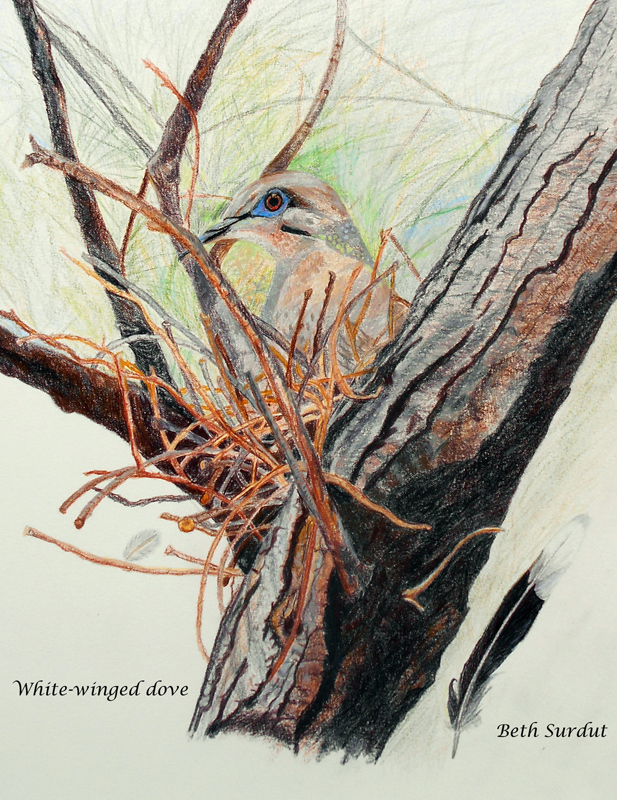
High-up in the imposing tamarisk tree outside my bedroom window, a migratory white-winged dove nestles like a plump teapot in the flat saucer where the branches fork. I can see the circle of blue highlighted with lavender around her bright orange eye as she bends her head to rearrange some sticks poking out around her. Her mate arrives with another slim stick in his beak and he stands on her back, drops the stick next to her, and then flies off for what seems to be a very long time before returning with another stick. Again, he stands on top of her, drops his gift, which slides away and shimmies through the air. He does not fly down to retrieve it, but instead returns to his favorite building supply area.
I think they must be new at this, but the more attention I pay, the more I learn that there is a lot that I don’t know about critters, even when I think I do.
By day two of construction, we have had rain—unusual, I’m told. The air sits sweet and sticky on my skin. The dove sits on her sticks. When hummingbirds build a nest, it is compact, dense, designed with tensile strength and lined with soft materials. Clearly, the doves didn’t get that memo. If these inhabitants were humans, they’d be on the road to divorce or looking for another architect and builder.
By day four, the nest looks like a skeleton ready to be filled in. Ms. Dove sits, but doesn’t stay. I take the opportunity to wrap my dressmaker’s tape around the tamarisk’s girth—41 inches tapering upwards to 36. I’m impressed. Though these trees are disliked for their lusty drinking habits and sloppy grooming, I see this one as a tree of life where not only the doves nest, but also, varieties of sparrows, hummingbirds, and verdins perch and call while collared lizards scuttle across the bulky outstretched base.
beth surdut dove unsized body image
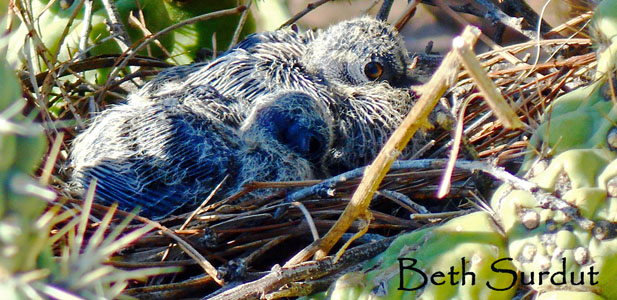
Later in the morning, as I’m watering the nearby bamboo, the dove pair returns. She nestles, he stands on top of her, his head above hers, and their heads turn towards me in unison as I walk by. The unlined, seemingly rickety, open-air nest that resembles a tangled pile of the game of Pick-Up Sticks proves to be a challenge for me to draw as I try to discern where the elements intersect. What appeared to be a haphazard pile, serves the purpose of holding mother and two eggs—usually two—until little pin-feathered beings grow viable feathers and fly to the ground after two weeks. Both parents watch over them during incubation and through this exploratory period, but doves are food for the Harris’ and Cooper’s hawks in my ‘hood.
Yet even with the losses due to predation, consider the seemingly ubiquitous presence of doves that pollinate saguaros and line the utility wires — I often count more than 20 — and the ones that fly out of the oleanders and eucalyptus as if flushed by hounds when I walk by. Look around for the nests—my neighbor has one built on the electrical outlet cover next to the light by her front door, another in the rhus lancia tree at the corner of her house, and a third on a crossbeam under her patio roof.
Last year, at the edge of a gravel road that leads to my house, the doves chose a labyrinthine mass of cholla with pointy twists and turns surrounded by prickly pear that seemed to present a formidable fortress. Sometimes, if the mother deemed I was too close—she had, after all, chosen a well-trodden path--she would fly off and pretend she was wounded, dropping one white-tipped wing and dragging it as she hopped along on the ground, making herself an obvious target.
A friend came to visit, arriving at my front door, saying “There was a Harris’ hawk standing on the ground just as I made the turn into here. I wonder why?’
I knew why. When I got there, the mother and two babies--they were not old enough to fly—were gone, feathers scattered, some standing upright like little grave markers.
This month marks a year that I’ve lived here, and I see nests being reconstructed in many of the same places. The current babies fledged in that cholla today—the mother was on the nest, father on a branch near her, and I found one youngster walking on the ground below them. I looked up into the trees and the utility pole tops where I usually see the hawks, listened for their distinctive calls, but heard only the drone of bees, the chittering of small birds, and the calls of the white-winged doves.
beth surdut baby dove nest photo unsized
The Art of Paying Attention Workshop
Observing nature starts with curiosity about what grows, flies, and crawls around you. Explore our integrated place in nature in a workshop with award-winning wildlife artist and writer Beth Surdut, creator of the illustrated Listening to Raven stories and The Art of Paying Attention NPR radio series.
Sponsored by Pima County and the USA National Phenology Network, for ages 12 and up.
Date & Time: Thursday, May 26, 2016 from 4:30 – 6:00 p.m.
Where: Pima County Agua Caliente Park, 12325 E. Roger Road
Cost: Free with park membership, non-member fee: $10. Pre-registration preferred..
Please bring a notebook!
For more information contact www.pima.gov/nrpr, eeducation@pima.gov, or call 520-615-7855
Visual storyteller Beth Surdut invites you to observe, with unbounded curiosity, the wild life that flies, crawls, and skitters along with us in our changing environment. From exotic orchids and poison dart frogs to local hawks and javelinas, Surdut illustrates her experiences with wild and cultivated nature by creating color-saturated silk paintings and detailed drawings accompanied by true stories.
You can find Surdut's drawings - and true stories about spirited critters - at listeningtoraven.com 
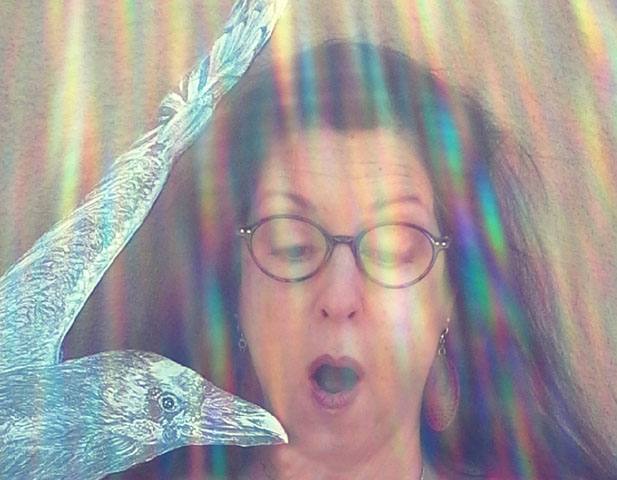
beth surdut with raven statue unsized
Beth Surdut's illustrated work Listening to Raven won the 2013 Tucson Festival of Books Literary Award for Non-Fiction. Elements of her raven clan have appeared in Orion Magazine, flown across the digitally looped Art Billboard Project in Albany, New York and roosted at the New York State Museum in an exhibition of international scientific illustrators.


Thursday, October 29, 2015

The Art of Paying Attention: Raven and the Flying Doritos® on NPR

Egg Thief Raven drawing © Beth Surdut (prints for sale)

“If you talk to the animals, they will talk with you and you will know each other.” ~Chief Dan George
I know ravens love junk food and they can even recognize a fast food logo, but I’m pickier than those clever corvids—Common or Chihuahuan—who I think of as equal opportunity eaters. Even knowing that eating almost anything helps sustain their big brains, I just can’t bring myself to feed them patties of processed animal parts. Usually, I don’t put out any food, but one day I placed two uncooked whole chicken eggs -- free range, of course -- on the lava rock watering hole in the garden.
The next morning, just as I got out of the shower, I heard gleeful quorks and gurgles through the window. Two huge ravens were sharing the eggs I’d put out for them. Feathers glowing like abalone in the cool sunlight, they nibbled and chatted. After that, the one I called the Egg Thief swooped in at least once a day to check on the chicken egg situation.
Even in winds so brisk the house howled like La Llorona mourning her children, he took one perfect egg in his beak and brought it over to his mate, who hopped impatiently in the desert. Ravens mate for life, so this guy was taken, but soon the single ones showed up, sometimes solo, other times in rowdy groups.
The Thing I Do for Love raven drawing Beth Surdut http://www.bethsurdut.com/listening-to-raven.html

The eggs were the main prize for the ravens, but from what I can see, some of my neighbors are fueled by the snack food industry. Fierce winds slammed open the lid of their trash can and tossed the contents as joyously as fans throwing underwear at rock stars. Plastic bags, caught in the prickly embrace of cholla, wave like surrender flags.
A large empty Doritos® bag, bright as a macaw, flutters its colors as the wind bounces it repeatedly against the bottom of the wall outside my studio. As I bend over to retrieve the bag, I hear big wings pushing the air—whish-whish-whish- and then a soft “clock-clock-clock-clock-clock” as Raven flies close over my head.
I stand and wave the bag. Raven circles, feet tucked up neatly.
“Clock-clock-clock,” he vocalizes. Not cluck— it sounds more like a gentle tick-tock, slightly seductive, longing, as if saying, “Oh, I want that; please give it to me.”
The wind revs its engines and drives me into the studio.
Still clutching the bag, I touch the tip of my tongue to the roof of my mouth and let it stick for a nanosecond, then repeat.

“Clock-clock-clock,” I practice as I sit down at my work table to draw Raven.
“Clock-clock-clock,” I say to myself, ready for our next conversation.
But not today. Alarm calls from smaller songbirds tell me that Raven is trying to steal babies or eggs from a nest. The screeches escalate as more birds join in to mob Raven, who decides this is too much work and takes off.
We’ll chat another time, Raven and I, especially if I put out more chicken eggs or a bag of chips.

Find more of Surdut's drawings and true stories about spirited critters at listeningtoraven.com and http://www.bethsurdut.com/critters.html
Beth Surdut's illustrated work Listening to Raven won the 2013 Tucson Festival of Books Literary Award for Non-Fiction. Elements of her raven clan have appeared in Orion Magazine, flown across the digitally looped Art Billboard Project in Albany, New York and roosted at the New York State Museum in an exhibition of international scientific illustrators.
"The Raven" segment of Encyclopedia of Santa Fe and Northern New Mexico by Mark Cross is illustrated with The Reason Why along with her explanation of Raven calling her to the Southwest to draw and collect first person stories of interactions with this clever corvid and iconic spirit guide.
Audio available for this raven conversation on NPR affiliate Arizona Public Media

Thursday, July 30, 2015

Harris'Hawks in the Hood


Harris' Hawks in the 'Hood, the newest installment of my illustrated radio pieces, is online now and airs Friday and Saturday on NPR 89.1 KUAT
https://radio.azpm.org/p/azspotlight/2015/7/30/69208-the-art-of-paying-attention-harris-hawks/

What started as


gradually became
and is currently


Visit http://www.bethsurdut.com/critters.html for more wild nature drawings and stories.