Showing posts with label NPR. Show all posts

Saturday, April 20, 2019

The Soul of an Octopus: conversing with Sy Montgomery


In 2016, I conducted an interview on NPR with naturalist and author Sy Montgomery about the consciousness and emotions of animals. In September 2019, her engaging memoir, How to  Be A Good Creature, was published, and our conversation continues.

In 2012, deeply involved in researching, drawing, and collecting true first-person encounters with ravens, I was lured from Santa Fe to Tucson by a perfect combination--a book festival, Sy Montgomery, and, in particular, her book of essays, Birdology: Adventures with Hip Hop Parrots, Cantankerous Cassowaries, Crabby Crows, Peripatetic Pigeons, Hens, Hawks, and Hummingbirds.
We met. I told Sy about my ravens, and a friendship was hatched.
In 2013, I returned to Tucson to accept the Tucson Festival of Books Literary Award for Non-Fiction for my illustrated book-in-progress, Listening to Raven. After calling out the news to the ravens around my studio, I called Sy, who was working on a book about octopuses – not octopi.


Sy Montgomery Interview
Conducted & transcribed by Beth Surdut 
contains additional content not heard in radio interview
Beth: Sy Montgomery. It’s so good to talk to you today. You know you really are a bold one. Your newest book, Soul of an Octopus, I looked at that and I thought, you were writing about animal cognition and emotion when even respected animal behaviorists— Jane Goodall, for instance—wasn’t publishing their own ideas because the scientific community wouldn’t accept them. Would you have been able to title a book Soul of an Octopus when you first started writing about animals?
Sy: No, absolutely not. You are so right, Beth. I think now, though, the world is ready to accept that animals have emotions and thoughts and feelings and that we are not alone in the universe in having consciousness. In fact, as you know, in 2012, the consortium of neuro-anatomists and neuroscientists and other scientists got together in Cambridge, in England, to write and sign the Cambridge Declaration on Consciousness saying that all mammals and birds, and certainly some invertebrates-- they mention octopuses specifically-- have what they called the neural substrate necessary to generate consciousness.
So what you and I have known, and many of your listeners have known for decades, and many humans have known for centuries, now is being recognized by scientists and philosophers who weren’t ready to acknowledge that even just a few decades ago.
Beth: Are you familiar with the quote from Thoreau—so this would be in the 1800s-- Thoreau said, “Surely the most important part of an animal is its anima, its vital spirit, on which is based its character and all the peculiarities by which it concerns us, yet most scientific books which treat of animals leave this out altogether.”
Sy: Wow, that’s a great quote. That is a fabulous quote. Well, he knew stuff. Thoreau knew stuff. That’s for sure. That’s the thing, you know.
You, too, you’re an excellent observer of the natural world. To those of us who watch and listen, these truths are revealed to us. And I think you have to almost purposely blinder yourself to the thoughts and feelings of animals to deny that they exist. And anyone who’s had a pet dog or a pet cat can see this, can testify to it. It’s a little harder to see in an octopus, maybe, because we don’t get see octopuses as much as we might want to. But of you look, it’s there.
Beth: Well, I look at all the animals you’ve written about-- the golden moon bear, the tree kangaroo, the kakapo, the tapirs, snow leopards. Those are either exotic or cuddly looking.
And then there are the ones you have to respect—the raptors, the falcons, the Harris’ hawks, the man-eating tigers.
But you’ve got this other group of beautiful interesting creatures that are so different from humans that some people are scared of them, some people loathe them—tarantula, snake, and octopus---Three hearts! Suckers!
Sy: Ayup, and tasting with your skin. And being able to slip through a tiny opening because you haven’t got any bones at all, and a brain that wraps around your throat, and arms that, if severed, can go off and do things including change color and even hunt prey—this can freak some people out.
But how many people watched ET and loved that alien. Loved that alien for both the way it could connect with its children friends, but also for the ways it was so different from humans. And here we have, right on our planet these alien creatures, but they live in our world. And to me that is so exciting, it’s such a privilege and a lot of these critters…I mean, you’re not necessarily going to bump into an octopus if you don’t live near an ocean, and particularly some of the deep sea species of octopus.
But spiders, even if you don’t have a tarantula, all of us can meet a spider. If your like me and don’t vacuum too much, there’s tons of them right in your basement. But these are alien creatures, too, have what we would consider super powers if they belonged to a mammal.
They can shed their skin; they can taste with their feet. Many spiders, if they hurt their leg, they can pull it off and eat it and grow a new one. Wouldn’t that be great if we could do that?
Being able to pull this amazing substance, stronger than steel that they can pull out of their bodies and build webs with this. Wow. These are incredible creatures, and yet they’re amazingly common.
And we should just walk around this world gobsmacked, I think, realizing all these complex lives going on around us. Animals with powers that we only dream of, and yet all of them are thinking and feeling much as we do, and all of them love their lives as we do.

Beth: I never thought that I would cry over the story of an octopus, but I did, I did.
Sy: Oh, Beth.
Beth: When one of the girls in your book thought that she had viable eggs and tended them…could you talk about what happens to an octopus when they have eggs.
Sy: Well, octopuses lay eggs at the end of their lives, and they do it in darkness, no one can really see this happen, but we would come in and day after day there would just be more and more eggs.
Their eggs are the size of a grain of rice each, and they’re hung almost like clusters of grapes which they glue to the ceiling and the walls of their lair.
And from the moment the female octopus starts laying, until the time she takes her dying breath of water, she is completely devoted to these eggs. She will never leave her lair. She will never leave her eggs. She will not go hunting for food and sometimes even if you hand her food she won’t accept it, because her job, her whole raison d’etre, now, is to protect and clean and fluff and tend these eggs.
And when Octavia laid eggs, it was a bittersweet moment for all of us at the aquarium because we had enjoyed interacting with her. She knew who we were. She would look us in the eye and come over changing color with emotion, with excitement. She’d change red, she’d be so excited to see us. And greet us and put her suckers on us and let us pet her and we would play with her.
But once she laid those eggs, never again would she want to do that, because this was far more important. So we would see her fluffing the eggs, cleaning the eggs with her suckers, using her siphon to blow water across them to keep them clean.
Protecting them from, even though there weren’t really any other predators in her tank, there was always a chance that the sunflower sea star might come over and want to eat some of her eggs, so she was guarding the. She was the most devoted mother.
And there were times that people would come by and look at the exhibit and the octopus wasn’t moving much and they would be like “oh, well, that’s boring.”
But then you’d point out, “No, that’s a mama octopus and look, here’s her eggs,” and then people would be fascinated.
And there were a group of teenage girls who I’ll never forget, who walked by her exhibit and one of the kids said, “Eeeuw, octopus-- gross. Oo, I bet it feels icky to touch it.”
And I said to these three girls, “But look, it’s a mama octopus and here’s the eggs” and instantly these girls changed their minds. Instantly, they were like “oh, how sweet” and they wanted to know more about her.
And after we’d talked for a little while and they stood in awe watching her tend to her hundred thousand eggs.
And when they left, one of girls said to me, “You take care of that little mama.”
And this was somebody they’d found repulsive just minutes before.

Beth: It seems that humans tend to gravitate towards animals that act like humans. I say that in quotes. I think that you and I both have an interest in animals that act like whoever they are, not mirrors of us. There are animals, that, like an octopus or a snake, that aren’t mirrors of us. How do you go about choosing the animals that you write about?
Sy: Well sometimes they choose me, and sometimes it’s a very careful choice.
My first book was an homage to my heroines--Jane Goodall, Dian Fossey and Birute Galdikas. And that book was about their relationship with their study animals. So, writing about those great apes was a great way for me to start my career writing about the minds of other animals because you know, we’re so closely related to a chimp, you can get a blood transfusion from a chimp. You look into the face of an orangutan and there’s that guy that took you to the prom in junior high. (Beth: laughter) They’re very much like us. But as interested as I am to find the similarities between us and other creatures, like you, I think I’m more fascinated by the differences.
Because this is what stretches our imagination. And also stretches the limits of our compassion. I mean, it makes us more compassionate to imagine, and conceive of and respect and care for other minds, minds that aren’t like our own. And that’s what really fascinates me.
I mean, Henry Beston was saying of animals in his wonderful book, The Outermost House, “You know, they are not underlings, they’re not brethren, they are other nations.”
They’re living by senses that we’ve lost or never achieved.
They can hear voices that we can’t. And this is totally true.
Animals have powers we don’t have: birds can see infrared light; um, octopuses can taste with their skin; um, spiders can shed their exoskeleton, which is more than just shedding your skin, it’s actually shedding your skeleton.
Um, animals have so many senses that we don’t and they’re able probe our world and know our world and know the truth of our world in a way that we can’t. And I love that.
So how do I pick the next critter to write about.
Sometimes it’s that lucky thing that you’re giving a talk on pink dolphins and you happen to meet the person who studies the tree kangaroos in Papua, New Guinea and that did really happen. And that’s how I ended up writing about tree kangaroos in Papua, New Guinea.
You’ll be in the Amazon writing about pink dolphins and you’ll meet the guy who eventually leads you to the golden moon bears.
And other times, I’ve made a deliberate choice and that was the case with octopus. I made a deliberate choice in that point in my career, feeling I’ve written mostly about vertebrate animals. Some of whom, can speak, like the birds, in perfect English to us.
But most of animate creation, most of animal life on our planet is invertebrate. And most life on our planet lives in the sea.
So I felt it like it was time for me to try to write about a marine invertebrate and write about its mind.
And that was what brought me, on that fateful day in March 2011, to the New England Aquarium where a keeper opened the tank that contained Athena, my first octopus.
And she reached for me from the water and I reached for her from the air and that changed my life forever and launched me on this book.


Tuesday, August 14, 2018

Face to face with a hummingbird

One day, I was working on a drawing, magnifying glass in one hand, ink pen in the other, when I heard wing beats —so close, I could feel the air puff on my forehead. I held my breath, raised only my eyes, and looked at the hummingbird looking at me. Face to face, we both seemed suspended in the heartbeat of the universe before the bird turned and flew out through the open door.
So much more to this story @ https://radio.azpm.org/s/37262-the-art-of-paying-attention…/

 My place, late afternoon. 106 degrees. The fountain was off, so although there was water on the lower levels, this hummingbird hovered until I turned on the pump and the bubbler appeared.

 Anna's hummingbird nest found in a Russian  olive tree and wasp nest found in a salt cedar.
Baby broad-tailed hummingbirds about to fledge. Ink and colored pencil on paper by Beth Surdut. Signed fine art prints available.

Wednesday, May 16, 2018

Paying Attention:The Adventures of HoHum, the Great Horned Owl

The Adventures of HoHum, the Great Horned Owl
© Beth Surdut 2017
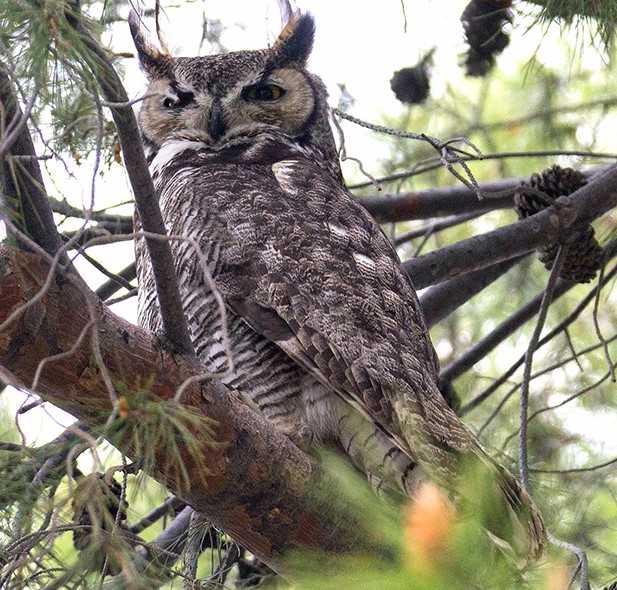
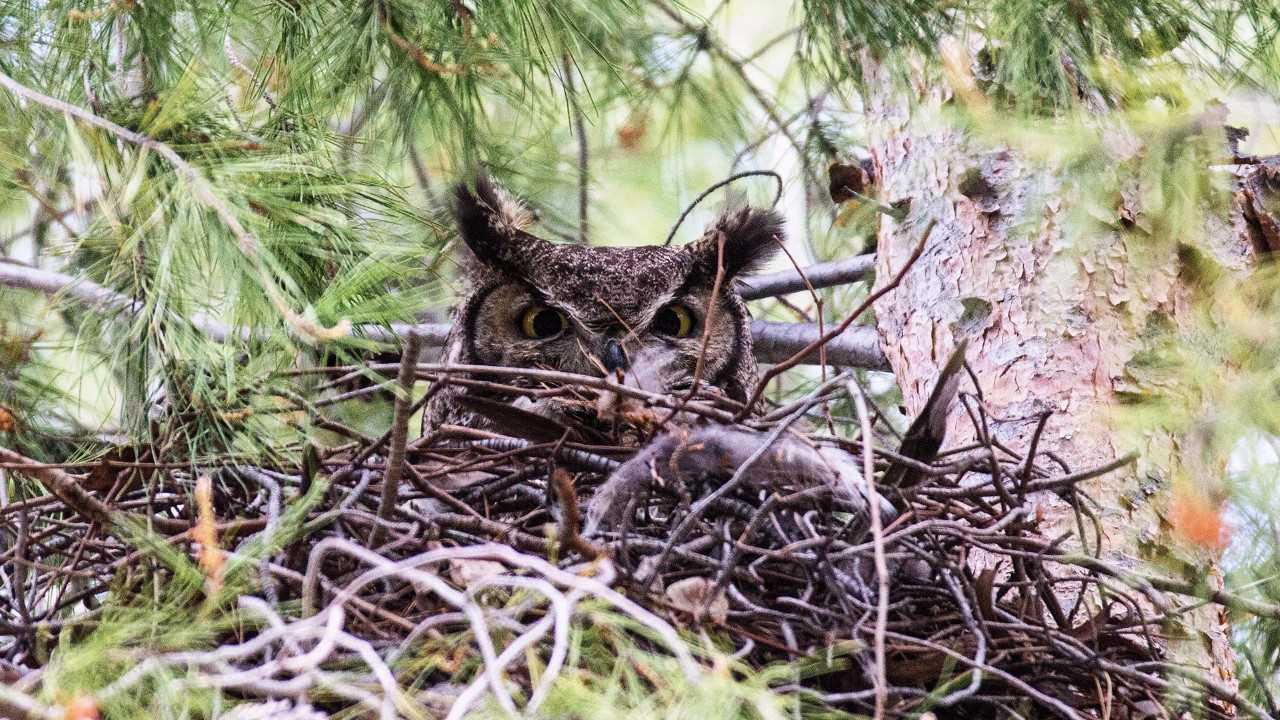
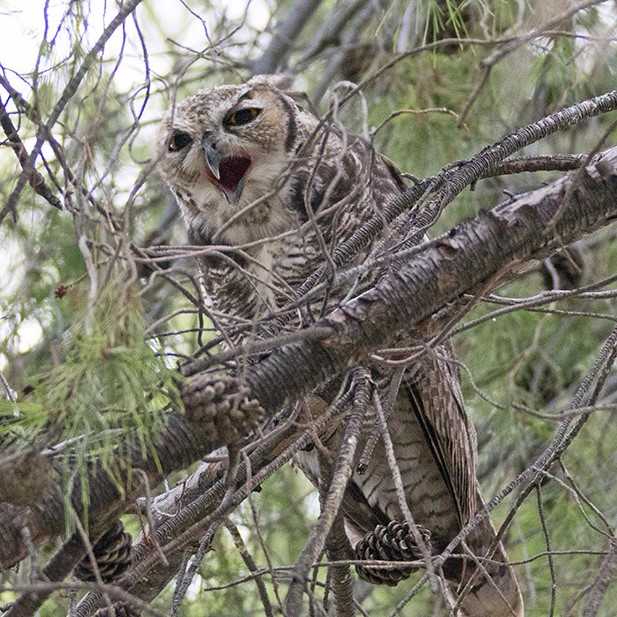
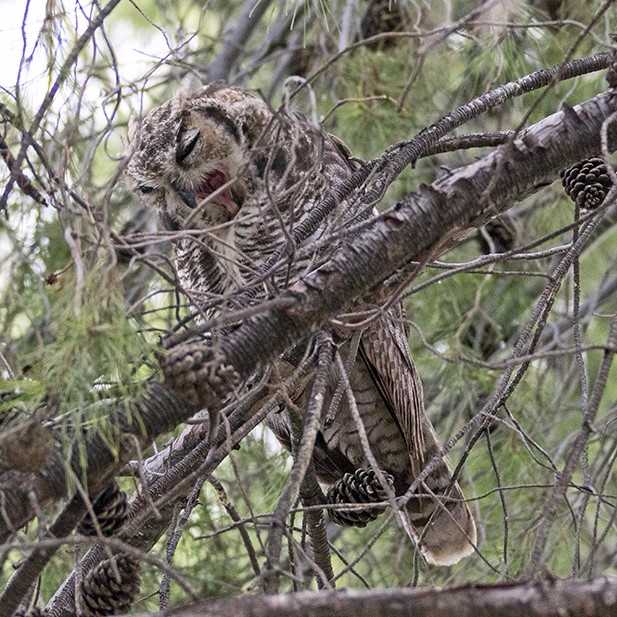
From the moment I spotted the two Great Horned Owl chicks—their big-eyed fuzzy heads rising above their bulky nest-- the larger one, would watch me. If I bobbled my head, that chick would mimic my motion. If I changed the direction, so would the bird. I named her Bobble. HoHum, the smaller one, would always be looking off somewhere, not seeming focused on anything in particular.

hohum the owl series 1
Tristan is Iseult's mate for life. (PHOTO: Doris Evans)
 
I’d witnessed the courtship of Bobble and HoHum’s parents. I named them Tristan and Iseult. Tristan is big, assured and impressive. From the top of his plumicorns—what appear to be horns, but are feathers-- to the points of his piercingly sharp talons, he is a model of his species. Except, according to statistics, he should actually be a she, because the female Great Horned Owl is usually larger than her mate. The male has a larger voice box and a deeper voice. Tristan not only has a deeper voice, but when the time came, he was not the one sitting on the nest. Funny how animals don’t read the manuals.
Let me orient you. There are three main trees in this story--sleeping tree, nesting tree, and hunting tree. The owls sometimes shift between them like a game of musical chairs.
HoHum the Owl hero 1
Iseult is the mother of owls named Bobble & HoHum. (PHOTO: Doris Evans)
 
Once mated for life, Tristan and Iseult moved about a block away into an old hawk’s nest lodged high up in the fork of an Aleppo pine tree. Tristan brought food to Iseult during the month she sat on the eggs. After the babies were born, he continued to supply rodents, rabbits, birds and anything else he could catch. As the chicks grew into fledglings, Iseult began to leave them to go hunting. Tristan would sleep each day in the pine tree where the courtship began.
One day, I arrived to find that the nest was empty. I headed for Tristan’s usual roost, but he was gone.
At first, the tree seemed empty, so I looked for clues on the ground. A dove’s egg—unblemished-- lay where it had fallen on a bed of pine needles. Then I saw some fresh white owl splashes. They almost glow in the dark. I started scanning the branches and spotted a fledgling.
hohum owl series 2
HoHum attempting to expel a pellet. (PHOTO: Doris Evans)
 
I moved a bit, so did the owl's head as it followed me. I rotated my head, then nodded up and down—so did the owlet. I’d found Bobble!
Bobble seemed young to be alone, so with more scanning I found HoHum, about 8 feet away from his sibling, gazing off into wherever, but, as usual, didn’t look at me.
I kept looking and, farther up, at a distance, but within sight of her offspring, I recognized Iseult. She is the smallest parent I've seen so far.
Each evening, Iseult would fly out and land in the hunting tree within sight of the sleeping tree. Bobble would soon follow. Eventually, HoHum would too, sometimes first making a soft alarm like a chicken squawk, a baby sound, before he lofted. Then they would fly out into the darkening sky to hunt, returning to the hunting tree to eat.
hohum owl series 3
Owls must expel pellets containing the indigestible parts of their prey before they can eat again, usually about every ten hours. (PHOTO: Doris Evans)
 
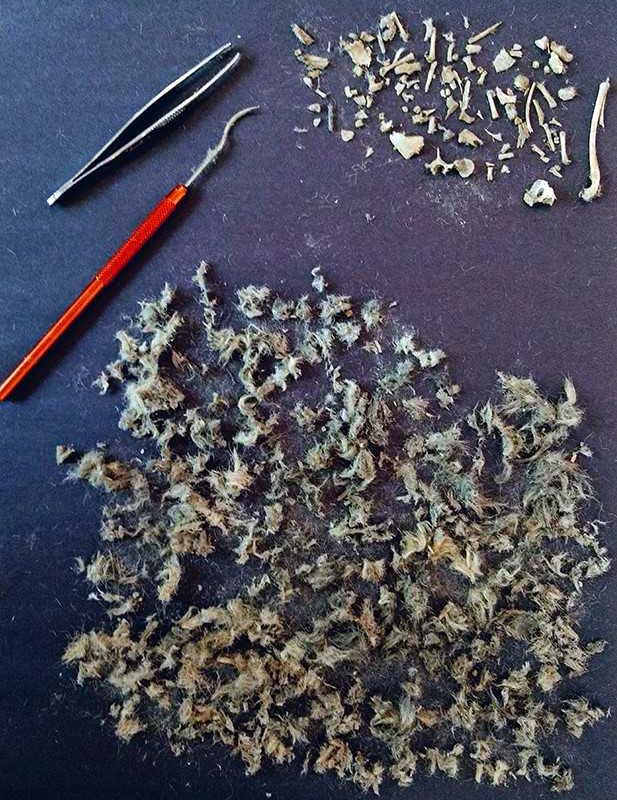
Daily, I found headless corpses, sometimes two at a time, under the hunting tree—a rabbit on its side—oh those soft little feet, a dove with twisted wings, a packrat sprawled on its belly. Owls usually eat every part and let their systems separate out the indigestible bones, beaks, fur, and feathers. I admire that efficiency. If the death of one creature feeds another, so be it. Finding the corpses made me cranky-- that sloppiness, that waste of life.
With each cycle I’ve watched, there is a time when the owls leave the familiar trees. I continue to visit the same places, feeling bereft at the absence, but eventually the cycle starts again, and I find a solo owl. This time, I heard a soft babyish alarm cry, steady, repeating in the sleeping tree. I looked up, up, up and there was HoHum.
Great horned owl  drawing by Beth Surdut
He sounded like a tired baby bird begging for food. The first time I found him alone, he continued to call as he flew to the hunting tree where he rocked to and fro like an unsteady tightrope walker. Then he lofted over to a more distant tree where he rocked again. He flew back to the hunting tree, and then returned to the sleeping tree. His cries grew softer, whimpering sounds, as night dropped its curtain on what I could see. I walked home, confused, having never heard this repetition of cries, nor witnessed this circling back at nightfall.
I visited HoHum almost every early evening before he flew out to hunt. This owl that had ignored me when his family was around, now cried softly as soon as he spotted me.
Unlike his younger days, he would watch me as I moved around under the tree where the monsoons exposed and scattered the contents of older pellets left by Tristan, Iseult, Bobble, and HoHum.
This miniature bone yard steamed with the earthy scents of rot that are usually masked by the aridness of the desert. Many of the pellets held only skulls.
dissected owl pellet unsized image
One of Tristan the Great Horned Owl's dissected pellets. (PHOTO: Beth Surdut)
 
Amidst the damp and layered dead animal parts and plant matter, I found most of a freshly killed packrat on its belly, back legs pointing in opposite directions, head and shoulders gone. The corpse was misplaced, because owls usually eat after returning to the hunting tree with prey. When I left, I could hear HoHum’s voice all the way to my house.
I called my friend Amanda Remsburg, a certified bird rehabilitator in Houston. I was curious about the headless corpses.
“So he’s practicing. He’s learning how to hunt, and so he’s going to take all the opportunities that he can to practice. He might have brought it back to his sleeping tree thinking, hmmm, maybe I’ll want this for later.” - Amanda Remsburg, Houston-based wild bird rehabilitator
I walked out to check on HoHum, but couldn’t find any owls. Then I heard two voices—one higher than the other-- hooting at dusk. At first, the calls came from the eucalyptus trees across the street from my house where I knew a family of Harris’ hawks lived.
A few days ago, I heard hooting in the area of the hunting tree. It was almost dark when I went on my own hunting expedition, looking for signs under trees. There they were—fresh bright white splashes… two pellets, and a bird skull partially coated with chewed up feathers! Just a skull. The hooting started, and then a second voice. The foliage was so dense, I couldn’t see the owls until one and then the other flew to the next tree. They were both small compared to Tristan.
It looks like HoHum found the companion he needs. I bet he never talks to me again, and that’s the way it should be.

beth surdut with raven statue unsized
Visual storyteller Beth Surdut invites you to observe, with unbounded curiosity, the wild life that flies, crawls, and skitters along with us in our changing environment. From exotic orchids and poison dart frogs to local hawks and javelinas, Surdut illustrates her experiences with wild and cultivated nature by creating color-saturated silk paintings and detailed drawings accompanied by true stories.
You can find Surdut's drawings and true stories about spirited critters at www.payingattentiontonature.com
Beth Surdut's illustrated work Listening to Raven won the 2013 Tucson Festival of Books Literary Award for Non-Fiction. Elements of her raven clan have appeared in Orion Magazine, roosted at the New York State Museum in an exhibition of international scientific illustrators. The clan has flown across the digitally looped Art Billboard Project in Albany, New York and her Townsend's Big-eared Bat hovered on its own billboard over Melrose Avenue in Los Angeles.

Saturday, April 28, 2018

The Art of Paying Attention: Mountain Lion

You Should Be So Lucky-- mountain lion, drawing by Beth Surdut

©Beth Surdut 2018                                     CLICK for AUDIO

When someone tells me that they have seen a mountain lion in the wild, or even that there might be one around, this frisson of excitement sparkles through me. 
Stories come to me from all sorts of people and places. My landlord came over to work on my clogged kitchen sink.  Passing by my work table, where I was finishing a drawing of a mountain lion, he told me about being in the Rincon Mountains ten or twelve years ago, collecting leopard frog data with friends. They were walking by a pond, when a mountain lion jumped out of some reeds on the far side, and ran away. Pete was the last person in line, hanging back, because he wanted to see what was in those reeds. He waded across the pond, maybe 30 feet, thinking there might be a kill or a den. He parted the reeds, and there was a second lion, lying down, with its back to him. He was so close he could have touched it.

“I thought she was asleep. She turned her body and looked at me. The hair on my arms stood up. She had beautiful eyes,” he said, and I could hear the wonder in his voice. He backed away, slowly, and kept going. The hair on my arms was standing up, too, and, just for a second, I was with him, and the mountain lion, holding my breath.

“Lucky you,” I said to him “to experience that.”
“Yes, yes, I was,” he said.  So, I named the drawing “You Should Be So Lucky.”

Cougar, puma, panther, and mountain lion are common names for the puma concolor—the largest cat that can purr, meow, caterwaul, and yowl, but not roar. A typical adult male--6 to 8 feet from nose to tail tip-- weighs 110 to 180 pounds; females--5 to 7 feet-- 80 to 130 pounds.
Mountain lions can run up to 45 miles per hour for short distances, leap 30 feet or more horizontally, 18 feet straight up, and 60 feet down. They are beautiful, powerful, mysterious, and often misunderstood.

Dan Collins, retired from law enforcement in California, saw a mountain lion in Sabino Canyon. He volunteers at Saguaro National Park West, where he offers a presentation called Mountain Lions: Beyond the Myth. Collins said that estimated numbers in Arizona are 2500-3,000.
With home ranges of 75 to 150 square miles--and those numbers vary depending on which study you read--the cats are hard to count.

University of Arizona professor Melanie Culver is a conservation geneticist who knows her scat. She has been studying mountain lion genetics in North and South America since 1990. In a recent conversation, she said, “There have been a lot of mountain lions in Arizona, but I don’t know that is always going to be so. They are the last large predator that have this very important role.” That role is that of wildlife managers. Extirpate them, you tip the balance, creating what’s called a trophic cascade. For example, without the presence of mountain lions and wolves, deer populations soar beyond healthy numbers. While there have been 25 reported human deaths by mountain lions since 1890, 1,000 people die every year in deer collisions with automobiles.

In 1909, Ernest Thompson Seton--wildlife illustrator, storyteller, and former animal bounty hunter turned wildlife advocate, wrote this:
 "Of all that has been written or is known of the American cougar, fully ninety-nine percent deals with how we may hunt, pursue, murder, and destroy this wonderful beautiful animal.”

In 1970, Arizona was the last state to stop offering bounties for killing cougars. It is still legal to trophy hunt big cats in this state--including by hounding and trapping.

In January, 1994, on a cold clear morning—the kind that bites your nose-- my Tucson friend Vicki Nordness and her two large dogs—a 100-pound malamute and a 75-pound Husky mutt-- walked out of her house in the Methow Valley in the North Cascade mountain range in Washington State. They hadn’t gone far when they heard hounds baying, their anxious voices bouncing around the valley. The snow was so deep, that Vicki went back home to put on her snow shoes. Starting out at 2100 feet above the valley floor, she followed the sound up another 500 feet, where she found chaos.
Six radio-collared hunting dogs had treed something. The pack was baying and lunging. Two hounds were fighting with each other, wrestling and rolling down the hill towards Vicki and her dogs, who had stopped about 100 feet away. The hounds tried to engage her dogs, so she barked at the hounds to sit, which sent them running back to the tree.
Then, she waited.
A man and a boy appeared, with guns and no snow shoes. They post-holed slowly through the deep snow, their legs disappearing with each step. Vicki, 40 years old, slight of build and strong of spirit, guessed the man to be about her age, the boy about eighteen.
After introducing herself, Vicki told them, “Whatever you have in that tree, I don’t want you to kill it. Is it a cougar?”
The man said, “I hope so. We’ve been chasing a cougar and her young all morning on our snowmobiles.”
Vicki asked, “Couldn’t you just take a picture?”
The boy said, “I want to stuff it and put in my living room. I’ve been waiting 5 years to get this permit. Let’s just respect our differences.”
An older man, walking more slowly than the others, approached them. He was the grandfather.
“What’s this worth to you guys?’ Vicki asked.
“What do you mean?” said the father.
“I’ll pay you not to kill it. How about 500 dollars?”
The grandfather said, “Okay, okay, we’ll just take pictures,” and he took out a little movie camera.
They all walked up to the Ponderosa pine where the hounds had been baying the whole time.

There was the cougar, about 15 feet off the ground.

As the men finally walked away, Vicki realized that she could walk up the slope to be 15 feet away from the tree and at eye level with the cougar.
One of the men turned and yelled that she wasn’t safe unless her dogs were baying.
Her dogs never looked at the cat; they focused on the men.
So there she sat, with the cougar, in the beautiful silence of the Ponderosa pine forest, her dogs by her side.
She returned the next morning and found the cougar’s tracks where it had walked away from the tree, from the hounds, from the men with guns, and from my friend, who told me that seeing a cougar in the wild, was the thrill of a lifetime. 


For more Art of Paying Attention from the NPR series, visit my Critters page Paying Attention to Nature

Saturday, January 13, 2018

The Art of Paying Attention: Gila Woodpecker

Paying Attention: Gila Woodpecker (Click for audio on NPR)
© Beth Surdut, 2018
Welcome to my 24-hour, all you can drink, outdoor bar. In other parts of the country, I served hummingbirds a combination of boiled water and sugar from these red feeders, but when I moved to Tucson, I had some surprise patrons belly up to the bar.
Gila woodpecker claims a cactus fruit, Tucson, AZ--drawing by Beth Surdut

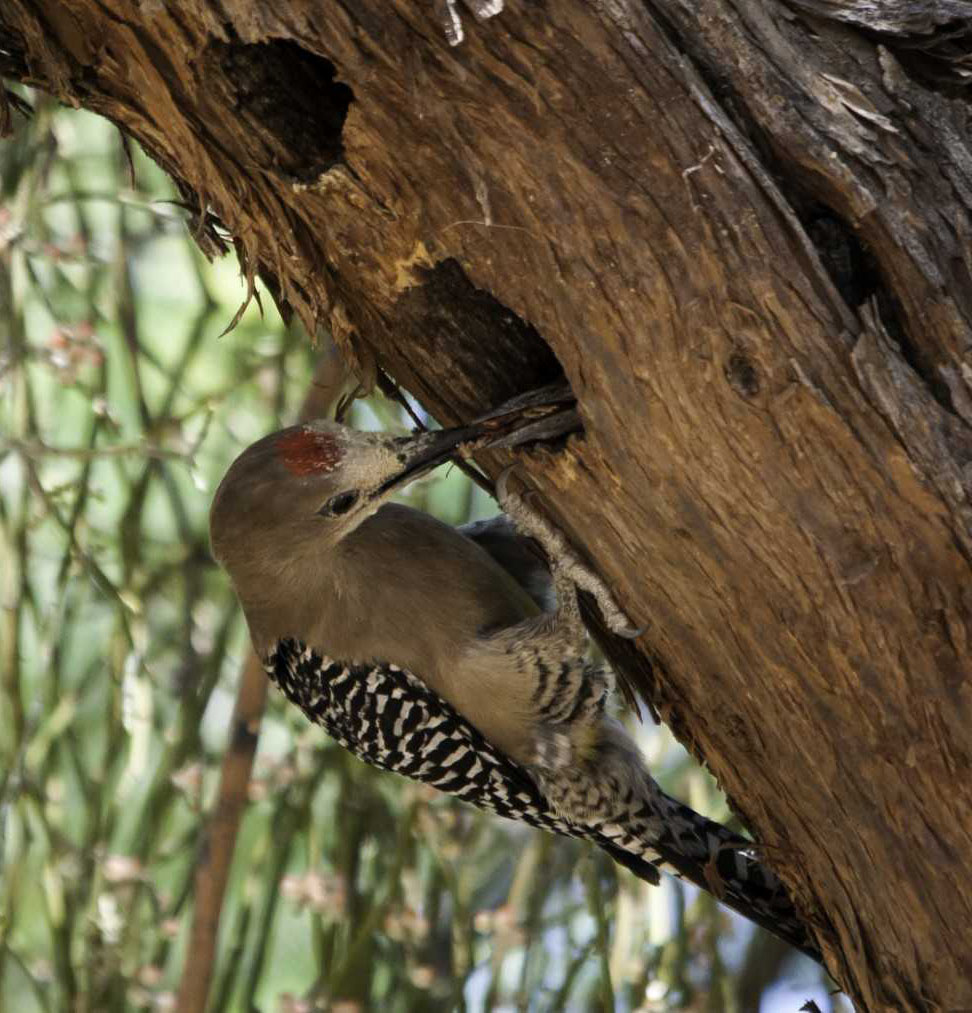
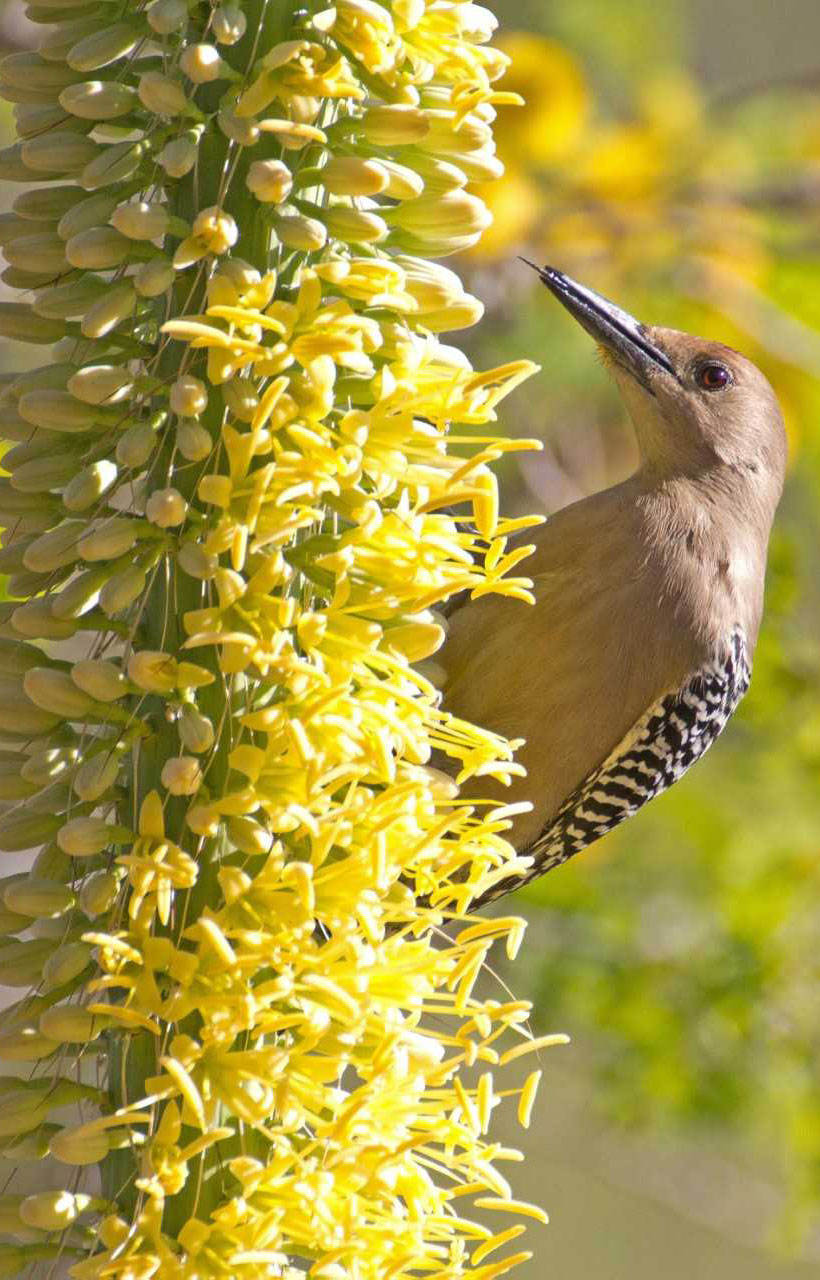
Gila woodpeckers — Latin name, Melanerpes uropygialis — are quite dapper, with black-and-white checkered and barred wings and tail, creamy cafĂ©-au-lait head and body, with a golden tinge on the belly, and distinctive white wing patches that show when they fly. The males sport what looks like a red lipstick streak on their heads. Their voices, clearly heard, even when competing with traffic noise, sound like squeak toys having a party.
Giddy talkers, they announce their arrival at my hummingbird feeders, which they drain almost daily, even after visiting the agave flowers.
The woodpeckers show up multiple times a day, announcing their arrival as they land, yakking as they jump down the bark to the feeder, still vocalizing when they land, and in-between drinks, calling back and forth from neighboring utility poles.
gila woodpecker in mesquite tree unsized body image
Gila woodpecker father feeds chick in a mesquite tree. (PHOTO: Peggy Coleman)

You should hear them amp up the sound when the feeder is empty! In summer and early fall, when the Lesser long-nosed bats drink from those same feeders every night until there is not a drop, the woodpeckers serve as my morning wake-up call.
Yet, unlike the resident Anna’s hummingbirds that share the feeder, hover around me, poke me, sometimes even follow me into the house when I carry the feeder in for a refill, the Gilas are always wary. Seeing me through the window, as I rise to attend to them, sends them fleeing, but they quickly return.
To me, woodpeckers are marvels of anatomical engineering.
Gila woodpeckers weigh about 3.5 ounces—the same as a deck of cards—and are 8-10 inches long. They have two toes pointing forward and two pointing backward that help them move on vertical surfaces, and very stiff tail feathers that they can press into even prickly cactus spines to help stabilize while whacking away.
Their sturdy beaks come to a gradual point, and are self-sharpening. They have as much chance of fitting into those hummingbird feeder holes as a camel does through the eye of a needle. When I first watched the woodpeckers stand on the feeder, tipping it with their weight as they pressed the end of the beak to the hole, I thought they were sloshing the liquid, so they could get a taste. I was wrong.
gila woodpecker tasting octopus agave unsized body image
A Gila woodpecker samples octopus agave blossoms. (PHOTO: Doris Evans)

What they do have in common with hummingbirds, are tongues so long that they wrap around their skulls. A woodpecker’s tongue is sticky and barbed at the end. It is guided by the flexible, muscle-covered hyoid bone that is attached at the right nostril, dividing into two parts between the eyes, wrapping all the way up and around the back of the skull. There, the separate pieces rejoin and attach to the muscle of the tongue. When the muscles surrounding the relaxed hyoid bone contract, they propel the tongue forward and out of the beak.
These birds bang on surfaces at an average of 12,000 times a day,15 miles per hour. The hyoid bone acts as a seatbelt for the bird’s brain, stabilizing the head and spine, protecting it from neurological trauma.
Woodpeckers’ brains are also tightly seated in their skulls—much more so than human brains, which can slosh on impact.
The upper beak is longer, so it absorbs more of the shock than the lower beak. The force travels up the beak, meeting the hyoid bone in the nostril, before hitting spongy bone in the skull. The stress then travels along the path of the hyoid bone, diffusing into the muscles that cover it.
gila woodpecker feeding young unsized body image
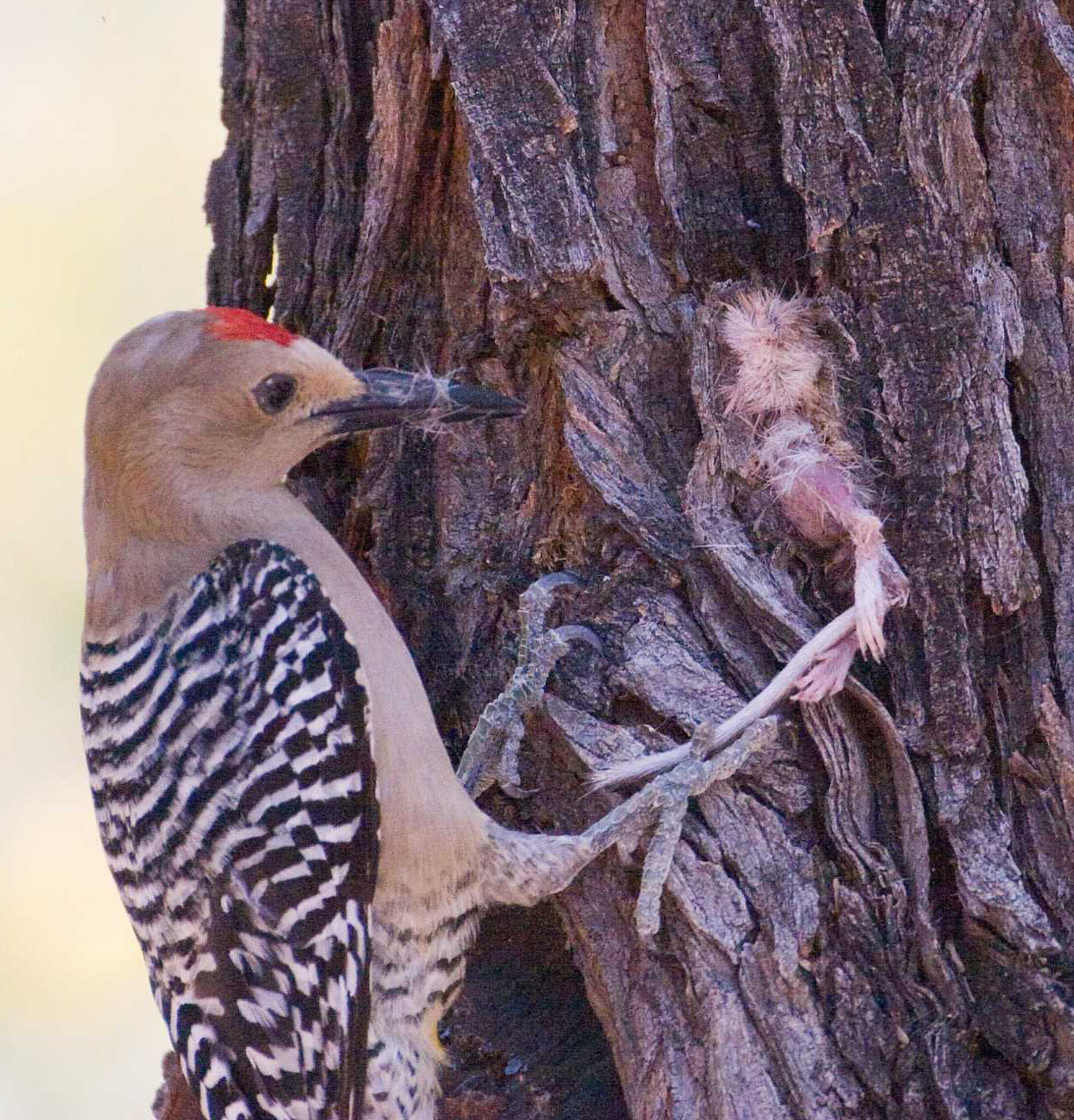
An omnivorous Gila woodpecker feeds its young a piece of a packrat. (PHOTO: Doris Evans)
 
Woodpeckers, who are omnivorous, glean insects from the surface of the bark. Their hearing is so astute, they can detect insect activity well below that, which may explain the added popularity of the rotting mesquite tree where a feeder hangs. The tap-tap-tapping isn’t all about food. On noisily resonant surfaces, such as metal screens and antennas, the birds are announcing their presence and territory.
Gila woodpeckers mate for life—unlike polygamous Acorn woodpeckers. During spring and summer, they are capable of producing two clutches of eggs—three to five each time-- and gestation period is only two weeks.
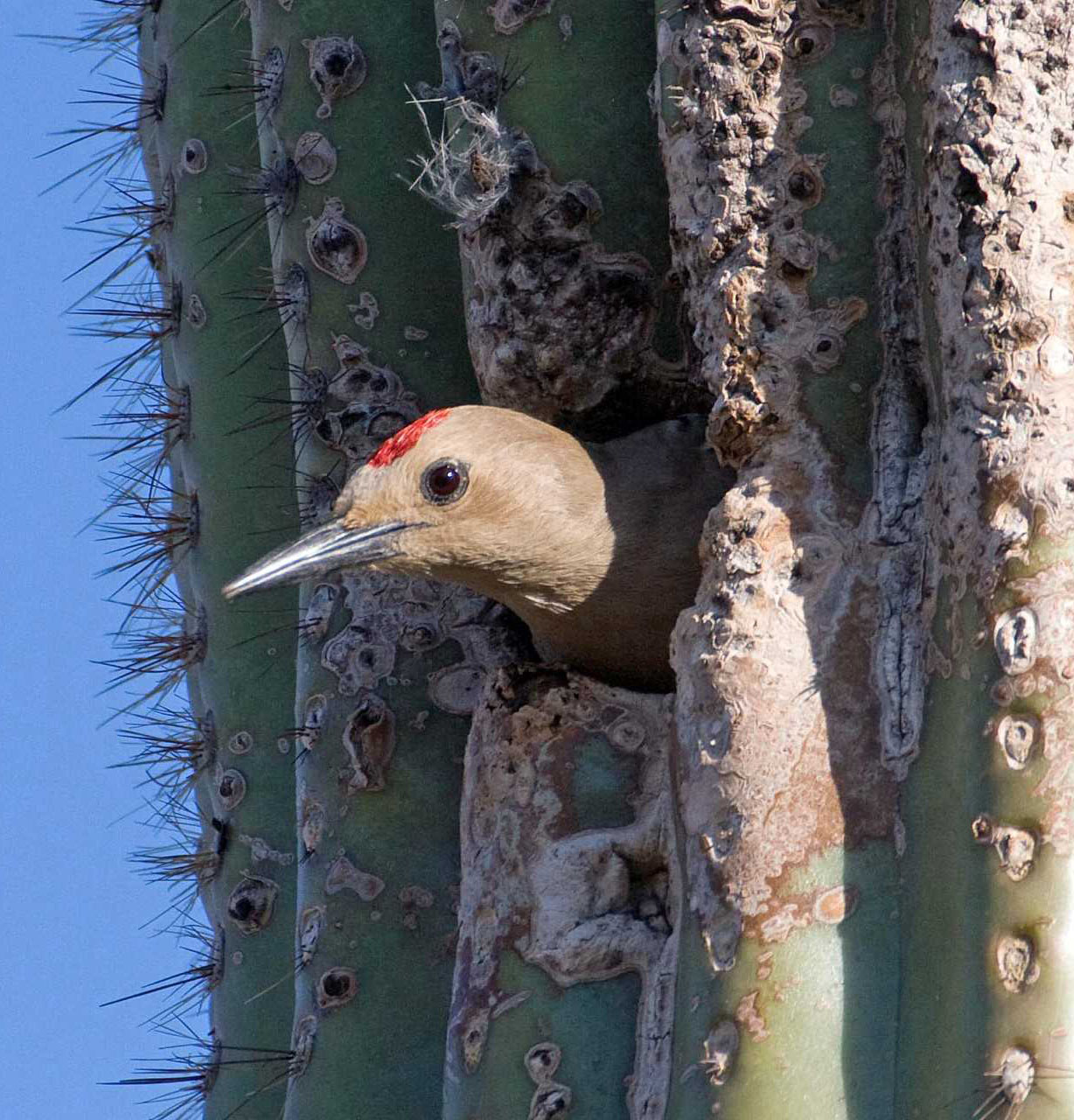
Both parents take part in nest building and feeding, usually in a mesquite tree or a saguaro cactus, which comes with the bonus of sweet fruit in summer.
gila woodpecker saguaro nest unsized body image
An omnivorous Gila woodpecker feeds its young a piece of a packrat. (PHOTO: Doris Evans) 

The birds perform a kind of surgery when they drill into a cactus to create a nesting site. The plant heals by covering the wound with sap that slowly hardens, forming a solid casing, called a boot. Drying time can take a few months, so holes are excavated, but not used until the next brood. And other birds, lizards, snakes, or rodents may move into these time-share condos.
Gila woodpecker families are around my house daily, so when I saw a fledgling with its head turned and tucked under fluffed-up feathers, unmoving on the ground under the mesquite tree, I wondered if there was a behavioral pattern I’d missed. The youngster didn’t move when I walked out and sat on a nearby bench, but eventually, it woke up and flew up to a neighbor’s roof. I went back to my drawing table, but an hour later, I saw a few people standing around the bird as it sat on a cement entryway. Something wasn’t right. I put the bird in a carrier, and rode with my neighbor to the Tucson Wildlife Center.
As the engine of her vintage sports car loudly rumbled, on what seemed like an endlessly long trip, I thought about the acuity of the bird’s hearing, and wondered if the reverberations along with the trauma would be too much for this little creature to bear. Despite its built-in protection, the woodpecker died 15 minutes after we arrived, probably due to internal injuries from a window strike.
I returned home to find another fledgling and its parent inspecting my newly planted barrel cactus. While I don’t put out bird seed, when it comes to the critters, I live to serve. For the almost three years I’ve been in Tucson, I’ve been filling the watering holes and keeping the sugar bar open, happily accepting my role as barista to the local wildlife.
One of my rewards, is being able to listen to the Gila woodpeckers talk as they tip the feeders and drink in the sweetness of life.

beth surdut with raven statue unsized
Visual storyteller Beth Surdut invites you to observe, with unbounded curiosity, the wild life that flies, crawls, and skitters along with us in our changing environment. From exotic orchids and poison dart frogs to local hawks and javelinas, Surdut illustrates her experiences with wild and cultivated nature by creating color-saturated silk paintings and detailed drawings accompanied by true stories.
You can find Surdut's drawings - and true stories about spirited wildlife at http://www.bethsurdut.com/critters.html and listeningtoraven.com
Beth Surdut's illustrated work Listening to Raven won the 2013 Tucson Festival of Books Literary Award for Non-Fiction. Elements of her raven clan have appeared in Orion Magazine, flown across the digitally looped Art Billboard Project in Albany, New York and roosted at the New York State Museum in an exhibition of international scientific illustrators.