Paying Attention: Gila Woodpecker (Click for audio on NPR)
© Beth Surdut, 2018
Welcome to my 24-hour, all you can drink, outdoor bar. In other parts
of the country, I served hummingbirds a combination of boiled water and
sugar from these red feeders, but when I moved to Tucson, I had some
surprise patrons belly up to the bar.
 |
| Gila woodpecker claims a cactus fruit, Tucson, AZ--drawing by Beth Surdut |
Gila woodpeckers — Latin name,
Melanerpes uropygialis — are
quite dapper, with black-and-white checkered and barred wings and tail,
creamy café-au-lait head and body, with a golden tinge on the belly, and
distinctive white wing patches that show when they fly. The males sport
what looks like a red lipstick streak on their heads. Their voices,
clearly heard, even when competing with traffic noise, sound like squeak
toys having a party.
Giddy talkers, they announce their arrival at my hummingbird feeders,
which they drain almost daily, even after visiting the agave flowers.
The woodpeckers show up multiple times a day, announcing their
arrival as they land, yakking as they jump down the bark to the feeder,
still vocalizing when they land, and in-between drinks, calling back and
forth from neighboring utility poles.
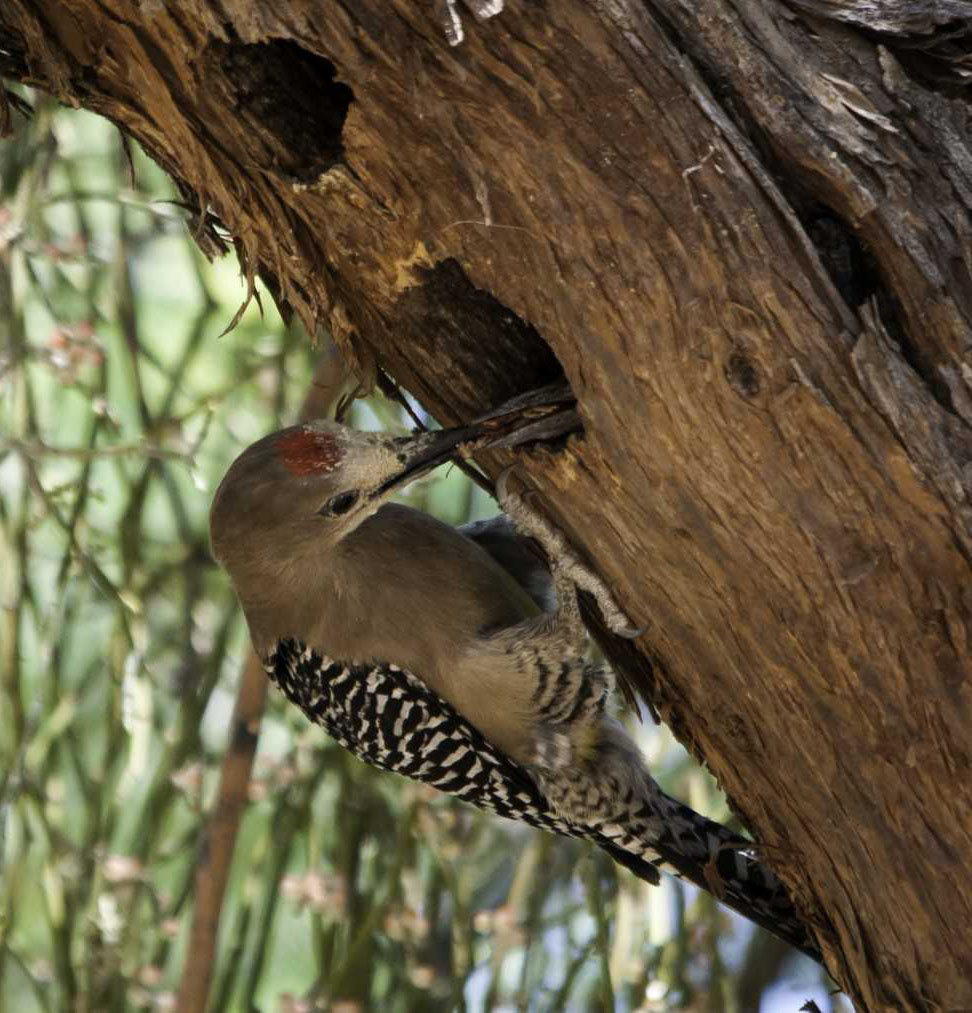 |
| Gila woodpecker father feeds chick in a mesquite tree. (PHOTO: Peggy Coleman) |
You should hear them amp up the sound when the feeder is empty! In
summer and early fall, when the Lesser long-nosed bats drink from those
same feeders every night until there is not a drop, the woodpeckers
serve as my morning wake-up call.
Yet, unlike the resident Anna’s hummingbirds that share the feeder,
hover around me, poke me, sometimes even follow me into the house when I
carry the feeder in for a refill, the Gilas are always wary. Seeing me
through the window, as I rise to attend to them, sends them fleeing,
but they quickly return.
To me, woodpeckers are marvels of anatomical engineering.
Gila woodpeckers weigh about 3.5 ounces—the same as a deck of
cards—and are 8-10 inches long. They have two toes pointing forward and
two pointing backward that help them move on vertical surfaces, and very
stiff tail feathers that they can press into even prickly cactus spines
to help stabilize while whacking away.
Their sturdy beaks come to a gradual point, and are self-sharpening.
They have as much chance of fitting into those hummingbird feeder holes
as a camel does through the eye of a needle. When I first watched the
woodpeckers stand on the feeder, tipping it with their weight as they
pressed the end of the beak to the hole, I thought they were sloshing
the liquid, so they could get a taste. I was wrong.
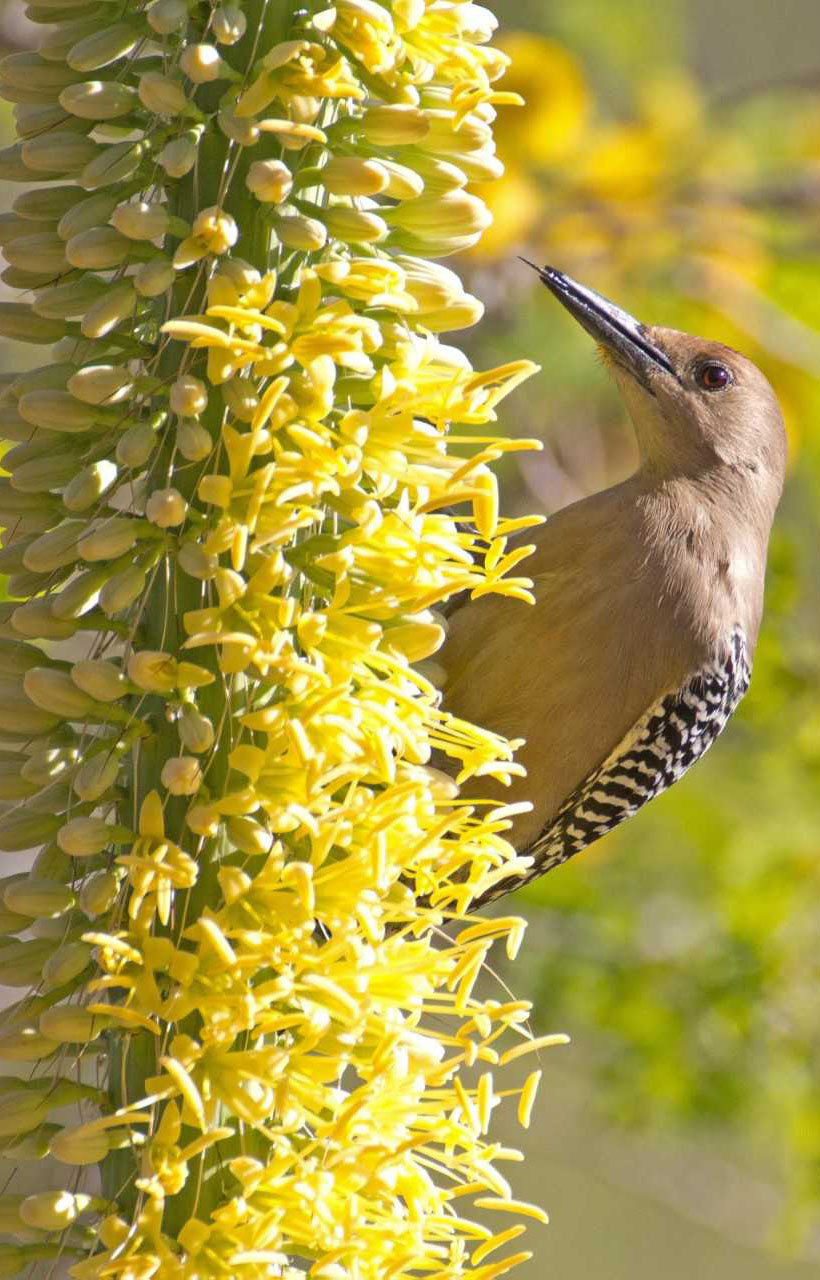 |
| A Gila woodpecker samples octopus agave blossoms. (PHOTO: Doris Evans)
|
What they do have in common with hummingbirds, are tongues so long
that they wrap around their skulls. A woodpecker’s tongue is sticky and
barbed at the end. It is guided by the flexible, muscle-covered hyoid
bone that is attached at the right nostril, dividing into two parts
between the eyes, wrapping all the way up and around the back of the
skull. There, the separate pieces rejoin and attach to the muscle of the
tongue. When the muscles surrounding the relaxed hyoid bone contract,
they propel the tongue forward and out of the beak.
These birds bang on surfaces at an average of 12,000 times a day,15
miles per hour. The hyoid bone acts as a seatbelt for the bird’s brain,
stabilizing the head and spine, protecting it from neurological trauma.
Woodpeckers’ brains are also tightly seated in their skulls—much more so than human brains, which can slosh on impact.
The upper beak is longer, so it absorbs more of the shock than the
lower beak. The force travels up the beak, meeting the hyoid bone in the
nostril, before hitting spongy bone in the skull. The stress then
travels along the path of the hyoid bone, diffusing into the muscles
that cover it.
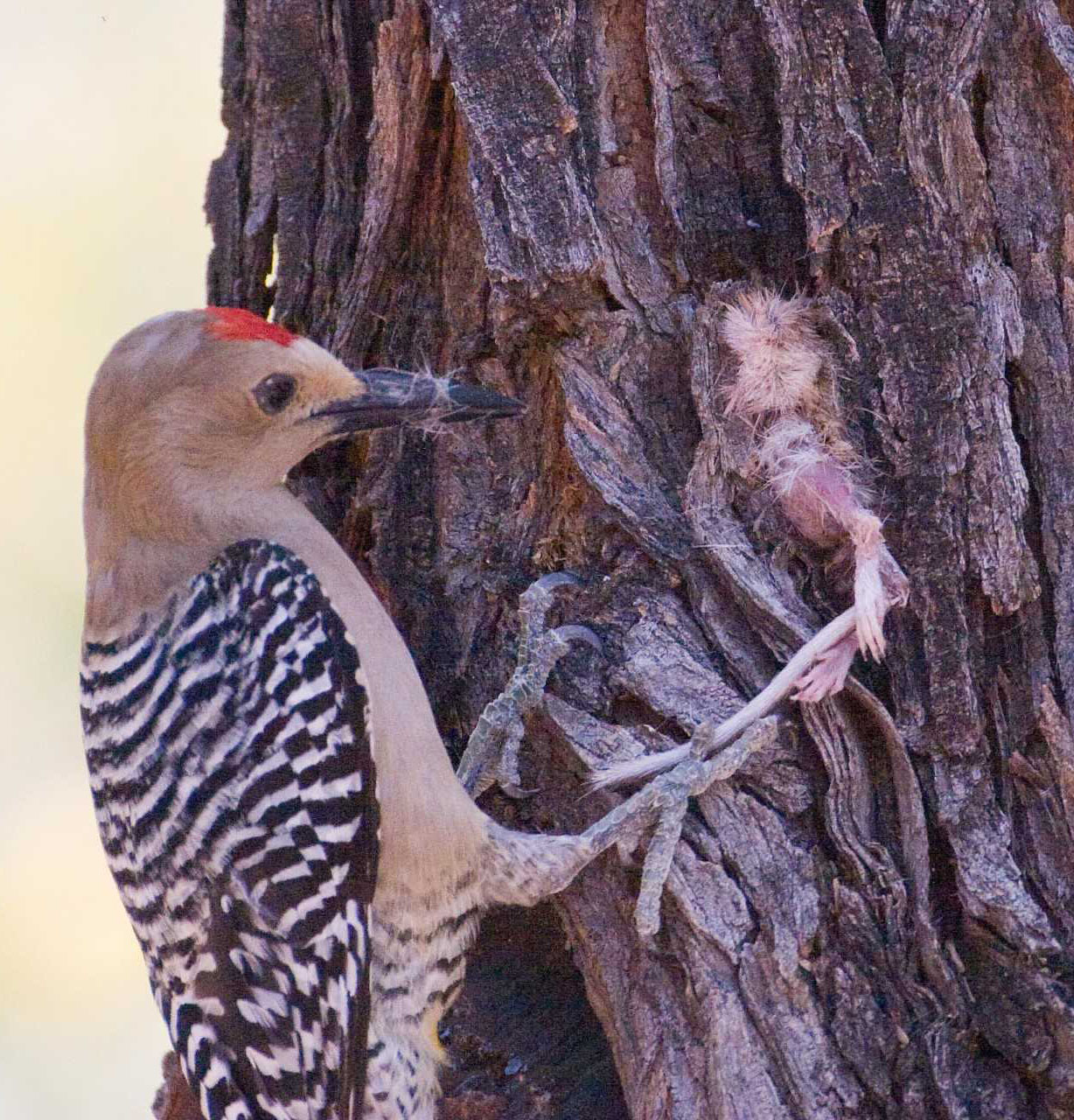 |
| An omnivorous Gila woodpecker feeds its young a piece of a packrat. (PHOTO: Doris Evans)
|
Woodpeckers, who are omnivorous, glean insects from the surface of
the bark. Their hearing is so astute, they can detect insect activity
well below that, which may explain the added popularity of the rotting
mesquite tree where a feeder hangs. The tap-tap-tapping isn’t all about
food. On noisily resonant surfaces, such as metal screens and antennas,
the birds are announcing their presence and territory.
Gila woodpeckers mate for life—unlike polygamous Acorn woodpeckers.
During spring and summer, they are capable of producing two clutches of
eggs—three to five each time-- and gestation period is only two weeks.
Both parents take part in nest building and feeding, usually in a
mesquite tree or a saguaro cactus, which comes with the bonus of sweet
fruit in summer.
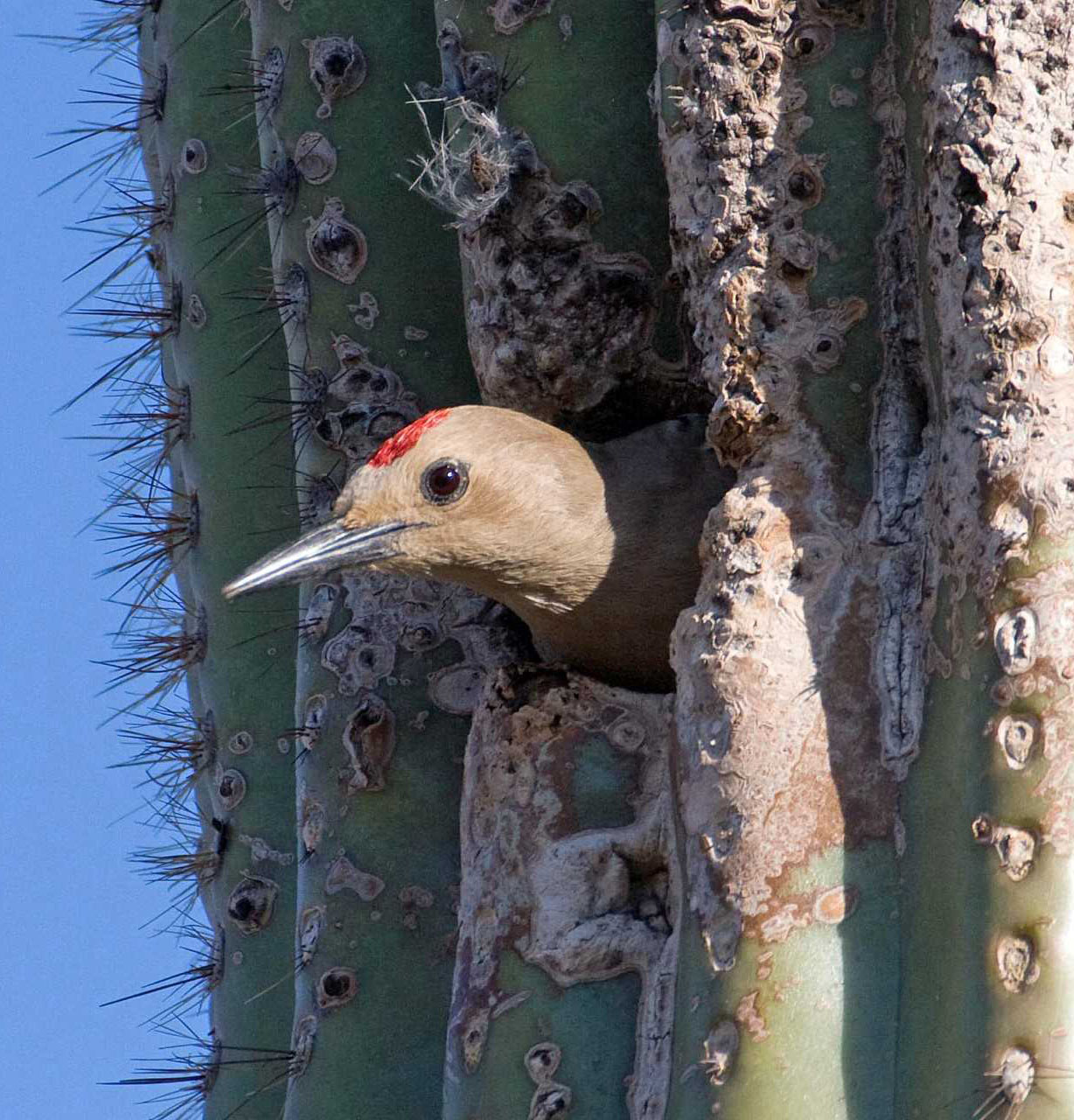 |
| An omnivorous Gila woodpecker feeds its young a piece of a packrat. (PHOTO: Doris Evans) |
The birds perform a kind of surgery when they drill into a cactus to
create a nesting site. The plant heals by covering the wound with sap
that slowly hardens, forming a solid casing, called a boot. Drying time
can take a few months, so holes are excavated, but not used until the
next brood. And other birds, lizards, snakes, or rodents may move into
these time-share condos.
Gila woodpecker families are around my house daily, so when I saw a
fledgling with its head turned and tucked under fluffed-up feathers,
unmoving on the ground under the mesquite tree, I wondered if there was a
behavioral pattern I’d missed. The youngster didn’t move when I walked
out and sat on a nearby bench, but eventually, it woke up and flew up to
a neighbor’s roof. I went back to my drawing table, but an hour later, I
saw a few people standing around the bird as it sat on a cement
entryway. Something wasn’t right. I put the bird in a carrier, and rode
with my neighbor to the Tucson Wildlife Center.
As the engine of her vintage sports car loudly rumbled, on what
seemed like an endlessly long trip, I thought about the acuity of the
bird’s hearing, and wondered if the reverberations along with the trauma
would be too much for this little creature to bear. Despite its
built-in protection, the woodpecker died 15 minutes after we arrived,
probably due to internal injuries from a window strike.
I returned home to find another fledgling and its parent inspecting
my newly planted barrel cactus. While I don’t put out bird seed, when it
comes to the critters, I live to serve. For the almost three years I’ve
been in Tucson, I’ve been filling the watering holes and keeping the
sugar bar open, happily accepting my role as barista to the local
wildlife.
One of my rewards, is being able to listen to the Gila woodpeckers
talk as they tip the feeders and drink in the sweetness of life.
Visual storyteller Beth Surdut invites you to observe, with
unbounded curiosity, the wild life that flies, crawls, and skitters
along with us in our changing environment. From exotic orchids and
poison dart frogs to local hawks and javelinas, Surdut illustrates her
experiences with wild and cultivated nature by creating color-saturated
silk paintings and detailed drawings accompanied by true stories.
You can find Surdut's drawings - and true stories about spirited wildlife at http://www.bethsurdut.com/critters.html and listeningtoraven.com
Beth Surdut's illustrated work Listening to Raven
won the 2013 Tucson Festival of Books Literary Award for Non-Fiction.
Elements of her raven clan have appeared in Orion Magazine, flown across
the digitally looped Art Billboard Project in Albany, New York and
roosted at the New York State Museum in an exhibition of international
scientific illustrators.







 Posts
Posts


