 |
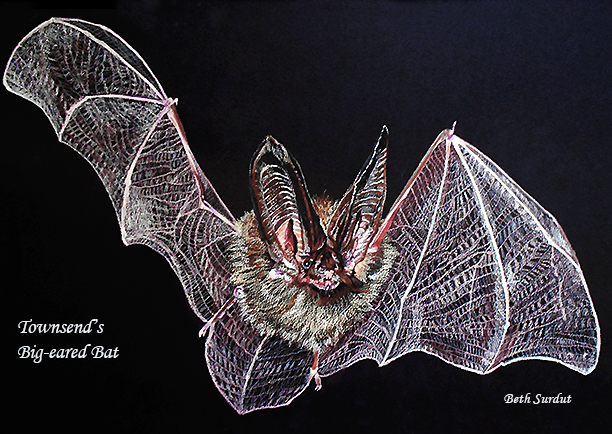
| Townsend's Big-eared Bat drawing by Beth Surdut |
Paying Attention: Bats
©Beth Surdut 2016
When a bat flies by me, the wing beats kiss my cheek in temptation,
and I hear a whispered invitation to learn the secrets of these
crepuscular creatures.
My initial search for Southwestern bat encounters brought me into the
Ortiz Mountains in New Mexico. Led by wildlife biologist Mike Roedel,
six of us waited at the mouth of the old Santo Niño mine. At sunset,
under a full moon in a lavender sky, I heard squeaks and rustling
amplified by a large metal cylinder lining the vertical shaft.
Townsend’s Big-eared bats began to fly out in ones and twos. Wings
swooshed by my head as I peered and listened for the next arrivals.
About 4 inches long, the bats looked like spirits…with rabbit ears.
Bats are the only mammals that can truly fly. They are of the order
chiroptera which translates as hand/wing. Whether designated as megabats
or microbats, the bone structure in their wings is similar to human
forearms and fingers, if ours were over 9 feet long and our bones could
bend. Microbats can locate objects in pitch-dark three-dimensional space
by emitting high-frequency sounds that bounce back. Using this
technique, called echolocation, they can figure out the texture and
speed of an object. And along with these natural superpowers, bats are
primary pollinators of saguaro and organ pipe cacti as well as hundreds
of species of agave plants.
Unless you are qualified, don’t touch bats. Saying that, I did! After
leaving a sacred monkey forest in Bali, I walked by a man working on
his front porch. A fruit bat, an old world megabat known as a flying
fox, hung like a large umbrella from the railing, watching. I asked in
Indonesian if the bat was
teman-- a friend. The man smiled,
gently hooked the bat over his arm, and moments later, I had broken my
rule of not touching wild animals. The bat hung from my wrist as I
stroked its suede-soft wings. It seemed to be grinning toothily as it
swung up towards my face to get a better look. The closeness of that
furry foxy face was a little disconcerting, but oh, those beautiful
limpid eyes.
Later, again in Bali, I stood at the entrance of a sacred and very
smelly bat cave that looked like a view into a many-storied tenement
building. Thousands of bats, tucked next to each other, stacked in rows
and clusters, slept, squabbled, interacted. One, who was quite obviously
a male, kept presenting to the bat next to him. As he repeatedly nudged
her, she tucked her wings tighter around her and over her head as if
indicating, “Not now, honey. I’m tired.”
While there is much that I will do to get to the great view, the
sacred place, the animal adventure, here in Tucson, I can just go
outside.
Arizona boasts 28 species of bats either migratory or year round.
There are Lesser long-nosed bats who drain hummingbird feeders each
night. I spoke with echolocation expert Janet Tyburec, who lives in
Tucson. When I asked if she had local favorites, she said, “Pallid bats!
They’re tough, wonderful, and they smell kind of like skunks and look
like little pigs.” She explained to me that they could heal fractures by
forming the equivalent of an internal walking cast around the damaged
part. They especially like high-end neighborhoods here, where they’ll
hang over the front door and porches as they eat centipedes and tear the
pincers off of scorpions before eating them.
For an impressive and easy view of bats in summer flight, you can
visit the migratory Mexican free-tailed bats that fly out at sunset from
under the bridge at Campbell Avenue and River Road. Towards the end of
July and into August, the numbers escalate as mothers and pups fly
together. Tyburec described the pups as “kind of klutzy at first, like
kids with learners’ permits.”
Even when you can’t see them in the dark crevices, you can tell where
the bats roost by the visible and scented lines of guano droppings. I
like to go before dark and wait to hear them wake up. These are social
sounds and, in my opinion, a special treat, because humans are not
capable of hearing most echolocation frequencies. Spotted bats
echolocate between 5-10 kHz-- well within the range of human hearing.Bats change the cadence and frequency of their calls when
they are approaching an object of interest and need more information
quickly.
Bats have existed for over 50 million years. With summer
temperatures often over 100 degrees in Arizona, we, too, become
creatures of the night. Lucky us, who can just go outside, and be
enhanced by the wing beats of bats in a star-filled sky.
Thanks to wildlife biologist Janet Tyburec for her assistance.
Want to know more about protecting bats?
Bat Conservation International
Merlin Tuttle's Bat Conservation
Arizona Game & Fish has a free "Bats of Arizona" poster available
here.




 Posts
Posts


