Showing posts with label Tucson Audubon. Show all posts

Saturday, March 16, 2019

No such bird as a black cardinal

Phainopepla, midtown Tucson. Greek meaning "shining robe," common name is silky flycatcher. You might just want to stop here and admire this handsome bird.

Or you can continue on to information that will make your Christmas extra special...


These birds feed on mistletoe, and hang out in mesquite trees, pooping seeds that result in parasitic plants that can take over the mesquite, and give humans an excuse to kiss strangers under a plant that translates as "dung stick." 

Saturday, August 11, 2018

Paying Attention: Fierce beauty

photo: Beth Surdut 2018

I'd been looking down for snakes as I walked in the desert heat,
 but when when I came round the bend, 
I immediately sensed I was being watched.
The Cooper's hawk was wary,
 in the way that predators are,
 but we both knew who had the right of  way.

photo: Beth Surdut 2018


I continued on, the lizards and bunnies all skittering and hopping away from me,
thinking they were running for their lives
even though they were taking the path to death.

I never shrug and burp up the pablum of "circle of life'
or "nature red in tooth and claw."
Instead, I hope that prey animals die immediately, 
not suffering, 
not wounded, 
not slowly suffocating,
not festering.
If death can be good, then may each precious little life die a good death.


Wednesday, May 16, 2018

Paying Attention:The Adventures of HoHum, the Great Horned Owl

The Adventures of HoHum, the Great Horned Owl
© Beth Surdut 2017
From the moment I spotted the two Great Horned Owl chicks—their big-eyed fuzzy heads rising above their bulky nest-- the larger one, would watch me. If I bobbled my head, that chick would mimic my motion. If I changed the direction, so would the bird. I named her Bobble. HoHum, the smaller one, would always be looking off somewhere, not seeming focused on anything in particular.
hohum the owl series 1
Tristan is Iseult's mate for life. (PHOTO: Doris Evans)
 
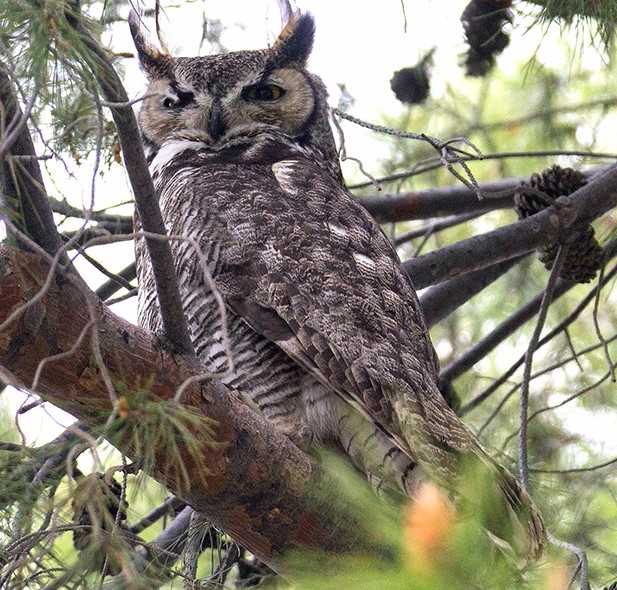
I’d witnessed the courtship of Bobble and HoHum’s parents. I named them Tristan and Iseult. Tristan is big, assured and impressive. From the top of his plumicorns—what appear to be horns, but are feathers-- to the points of his piercingly sharp talons, he is a model of his species. Except, according to statistics, he should actually be a she, because the female Great Horned Owl is usually larger than her mate. The male has a larger voice box and a deeper voice. Tristan not only has a deeper voice, but when the time came, he was not the one sitting on the nest. Funny how animals don’t read the manuals.
Let me orient you. There are three main trees in this story--sleeping tree, nesting tree, and hunting tree. The owls sometimes shift between them like a game of musical chairs.
HoHum the Owl hero 1
Iseult is the mother of owls named Bobble & HoHum. (PHOTO: Doris Evans)
 
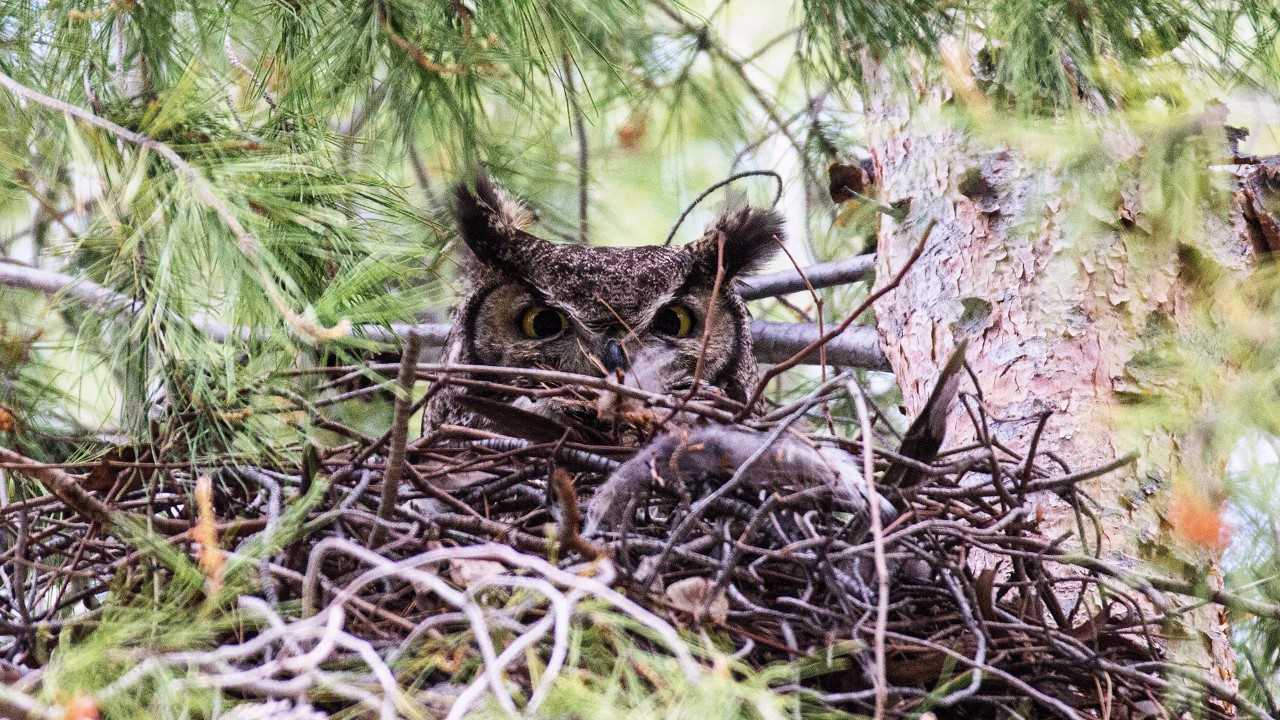
Once mated for life, Tristan and Iseult moved about a block away into an old hawk’s nest lodged high up in the fork of an Aleppo pine tree. Tristan brought food to Iseult during the month she sat on the eggs. After the babies were born, he continued to supply rodents, rabbits, birds and anything else he could catch. As the chicks grew into fledglings, Iseult began to leave them to go hunting. Tristan would sleep each day in the pine tree where the courtship began.
One day, I arrived to find that the nest was empty. I headed for Tristan’s usual roost, but he was gone.
At first, the tree seemed empty, so I looked for clues on the ground. A dove’s egg—unblemished-- lay where it had fallen on a bed of pine needles. Then I saw some fresh white owl splashes. They almost glow in the dark. I started scanning the branches and spotted a fledgling.
hohum owl series 2
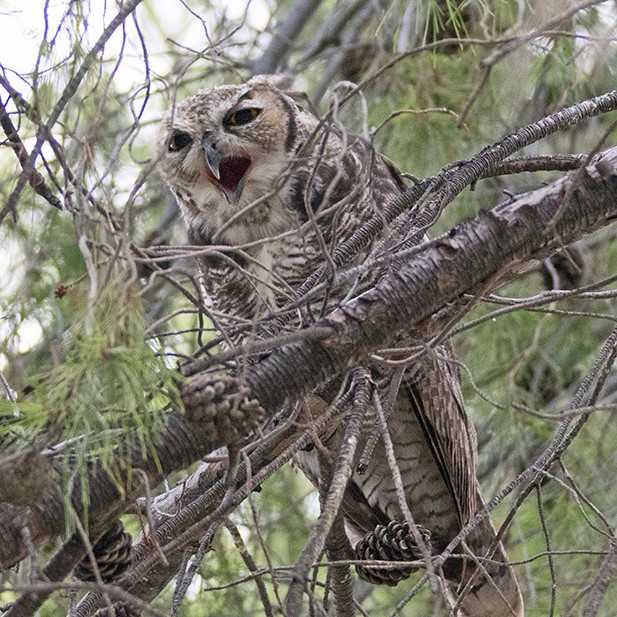
HoHum attempting to expel a pellet. (PHOTO: Doris Evans)
 
I moved a bit, so did the owl's head as it followed me. I rotated my head, then nodded up and down—so did the owlet. I’d found Bobble!
Bobble seemed young to be alone, so with more scanning I found HoHum, about 8 feet away from his sibling, gazing off into wherever, but, as usual, didn’t look at me.
I kept looking and, farther up, at a distance, but within sight of her offspring, I recognized Iseult. She is the smallest parent I've seen so far.
Each evening, Iseult would fly out and land in the hunting tree within sight of the sleeping tree. Bobble would soon follow. Eventually, HoHum would too, sometimes first making a soft alarm like a chicken squawk, a baby sound, before he lofted. Then they would fly out into the darkening sky to hunt, returning to the hunting tree to eat.
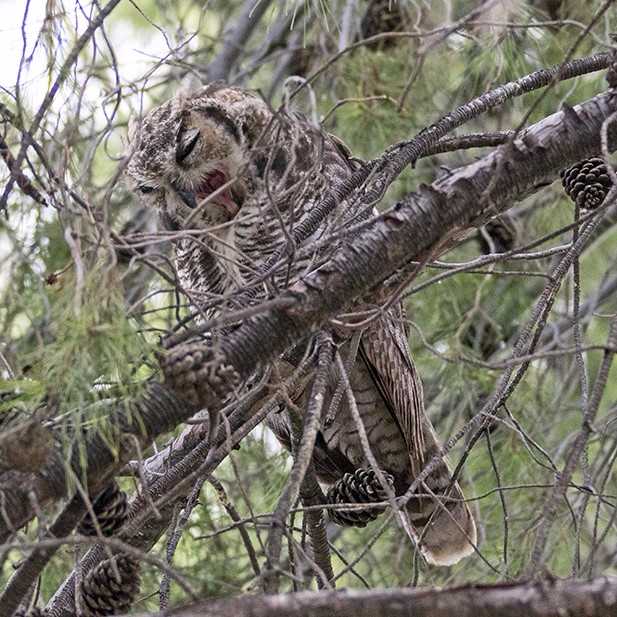
hohum owl series 3
Owls must expel pellets containing the indigestible parts of their prey before they can eat again, usually about every ten hours. (PHOTO: Doris Evans)
 
Daily, I found headless corpses, sometimes two at a time, under the hunting tree—a rabbit on its side—oh those soft little feet, a dove with twisted wings, a packrat sprawled on its belly. Owls usually eat every part and let their systems separate out the indigestible bones, beaks, fur, and feathers. I admire that efficiency. If the death of one creature feeds another, so be it. Finding the corpses made me cranky-- that sloppiness, that waste of life.
With each cycle I’ve watched, there is a time when the owls leave the familiar trees. I continue to visit the same places, feeling bereft at the absence, but eventually the cycle starts again, and I find a solo owl. This time, I heard a soft babyish alarm cry, steady, repeating in the sleeping tree. I looked up, up, up and there was HoHum.
Great horned owl  drawing by Beth Surdut
He sounded like a tired baby bird begging for food. The first time I found him alone, he continued to call as he flew to the hunting tree where he rocked to and fro like an unsteady tightrope walker. Then he lofted over to a more distant tree where he rocked again. He flew back to the hunting tree, and then returned to the sleeping tree. His cries grew softer, whimpering sounds, as night dropped its curtain on what I could see. I walked home, confused, having never heard this repetition of cries, nor witnessed this circling back at nightfall.
I visited HoHum almost every early evening before he flew out to hunt. This owl that had ignored me when his family was around, now cried softly as soon as he spotted me.
Unlike his younger days, he would watch me as I moved around under the tree where the monsoons exposed and scattered the contents of older pellets left by Tristan, Iseult, Bobble, and HoHum.
This miniature bone yard steamed with the earthy scents of rot that are usually masked by the aridness of the desert. Many of the pellets held only skulls.
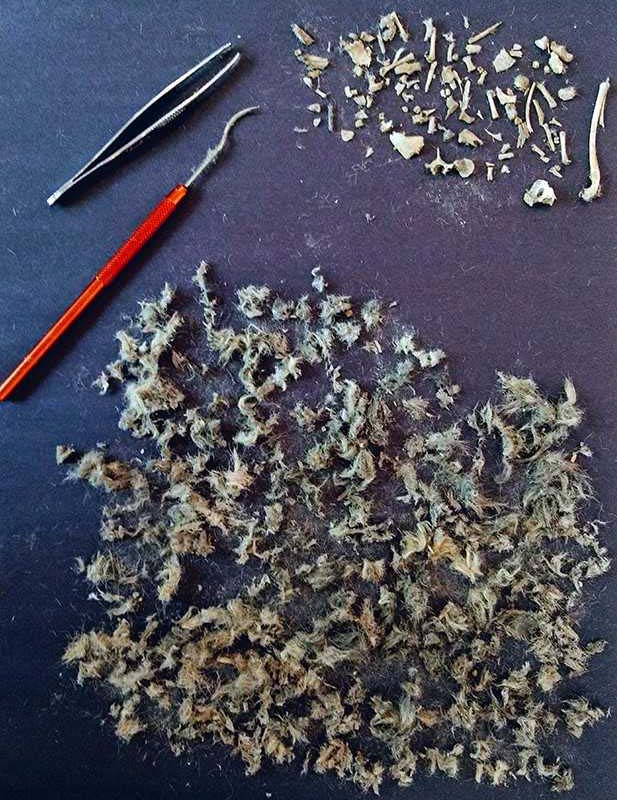
dissected owl pellet unsized image
One of Tristan the Great Horned Owl's dissected pellets. (PHOTO: Beth Surdut)
 
Amidst the damp and layered dead animal parts and plant matter, I found most of a freshly killed packrat on its belly, back legs pointing in opposite directions, head and shoulders gone. The corpse was misplaced, because owls usually eat after returning to the hunting tree with prey. When I left, I could hear HoHum’s voice all the way to my house.
I called my friend Amanda Remsburg, a certified bird rehabilitator in Houston. I was curious about the headless corpses.
“So he’s practicing. He’s learning how to hunt, and so he’s going to take all the opportunities that he can to practice. He might have brought it back to his sleeping tree thinking, hmmm, maybe I’ll want this for later.” - Amanda Remsburg, Houston-based wild bird rehabilitator
I walked out to check on HoHum, but couldn’t find any owls. Then I heard two voices—one higher than the other-- hooting at dusk. At first, the calls came from the eucalyptus trees across the street from my house where I knew a family of Harris’ hawks lived.
A few days ago, I heard hooting in the area of the hunting tree. It was almost dark when I went on my own hunting expedition, looking for signs under trees. There they were—fresh bright white splashes… two pellets, and a bird skull partially coated with chewed up feathers! Just a skull. The hooting started, and then a second voice. The foliage was so dense, I couldn’t see the owls until one and then the other flew to the next tree. They were both small compared to Tristan.
It looks like HoHum found the companion he needs. I bet he never talks to me again, and that’s the way it should be.

beth surdut with raven statue unsized
Visual storyteller Beth Surdut invites you to observe, with unbounded curiosity, the wild life that flies, crawls, and skitters along with us in our changing environment. From exotic orchids and poison dart frogs to local hawks and javelinas, Surdut illustrates her experiences with wild and cultivated nature by creating color-saturated silk paintings and detailed drawings accompanied by true stories.
You can find Surdut's drawings and true stories about spirited critters at www.payingattentiontonature.com
Beth Surdut's illustrated work Listening to Raven won the 2013 Tucson Festival of Books Literary Award for Non-Fiction. Elements of her raven clan have appeared in Orion Magazine, roosted at the New York State Museum in an exhibition of international scientific illustrators. The clan has flown across the digitally looped Art Billboard Project in Albany, New York and her Townsend's Big-eared Bat hovered on its own billboard over Melrose Avenue in Los Angeles.

Saturday, January 13, 2018

The Art of Paying Attention: Gila Woodpecker

Paying Attention: Gila Woodpecker (Click for audio on NPR)
© Beth Surdut, 2018
Welcome to my 24-hour, all you can drink, outdoor bar. In other parts of the country, I served hummingbirds a combination of boiled water and sugar from these red feeders, but when I moved to Tucson, I had some surprise patrons belly up to the bar.
Gila woodpecker claims a cactus fruit, Tucson, AZ--drawing by Beth Surdut

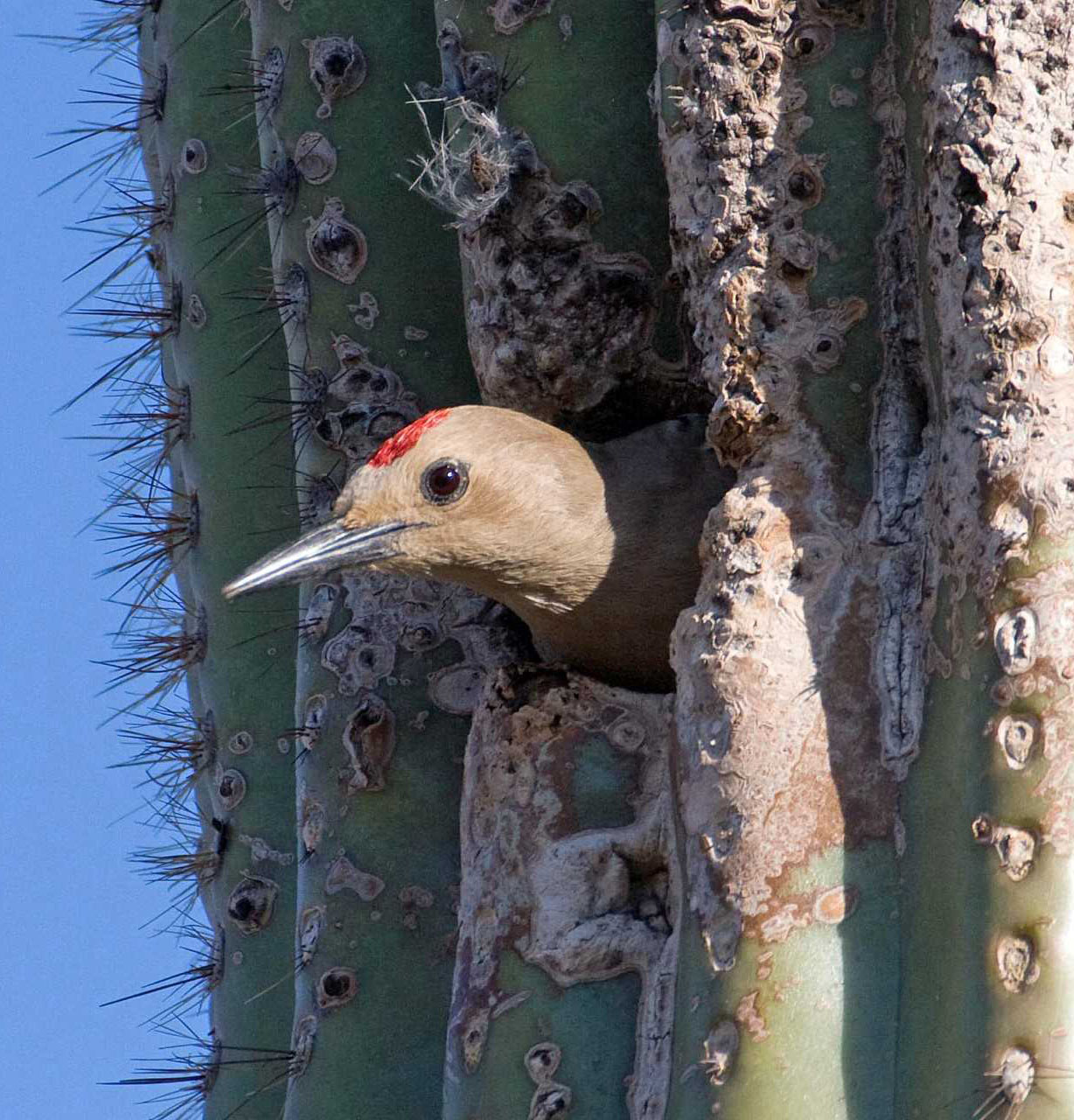
Gila woodpeckers — Latin name, Melanerpes uropygialis — are quite dapper, with black-and-white checkered and barred wings and tail, creamy cafĂ©-au-lait head and body, with a golden tinge on the belly, and distinctive white wing patches that show when they fly. The males sport what looks like a red lipstick streak on their heads. Their voices, clearly heard, even when competing with traffic noise, sound like squeak toys having a party.
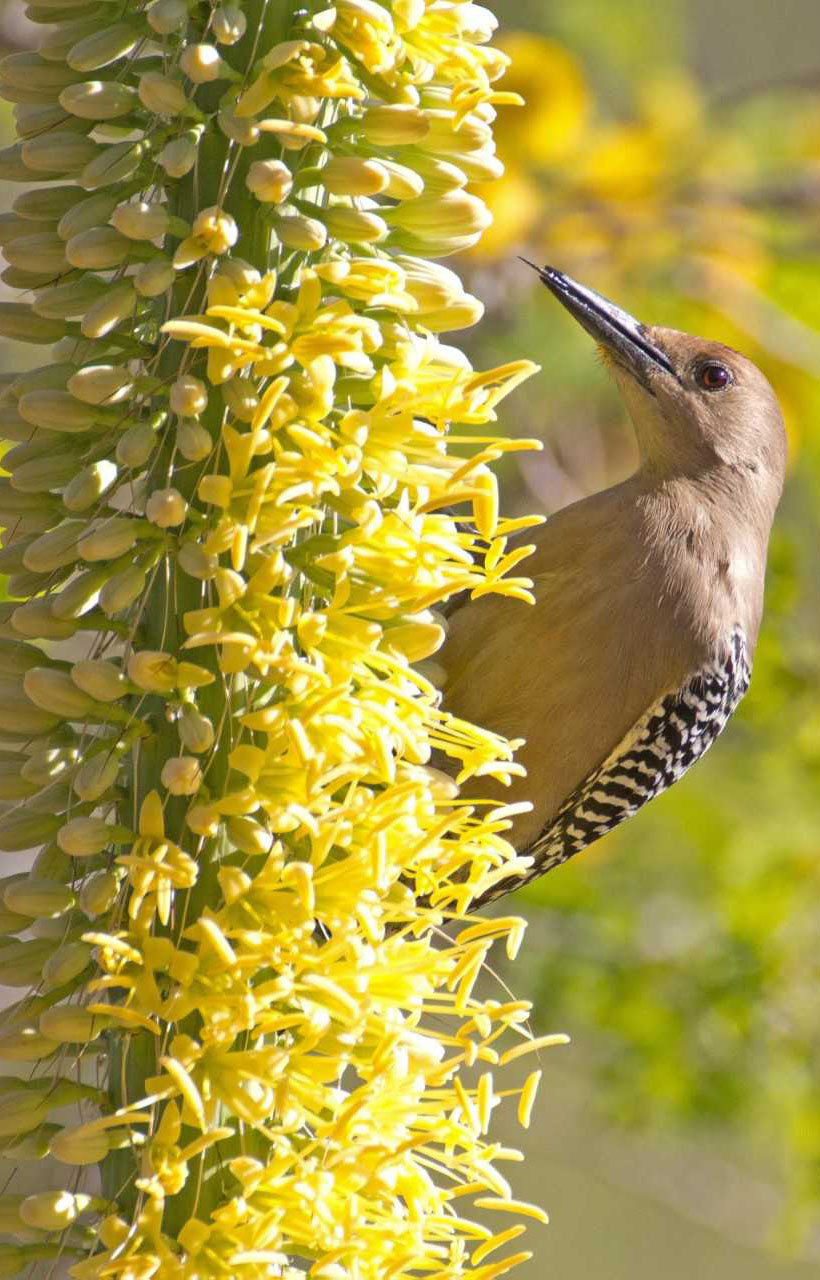
Giddy talkers, they announce their arrival at my hummingbird feeders, which they drain almost daily, even after visiting the agave flowers.
The woodpeckers show up multiple times a day, announcing their arrival as they land, yakking as they jump down the bark to the feeder, still vocalizing when they land, and in-between drinks, calling back and forth from neighboring utility poles.
gila woodpecker in mesquite tree unsized body image
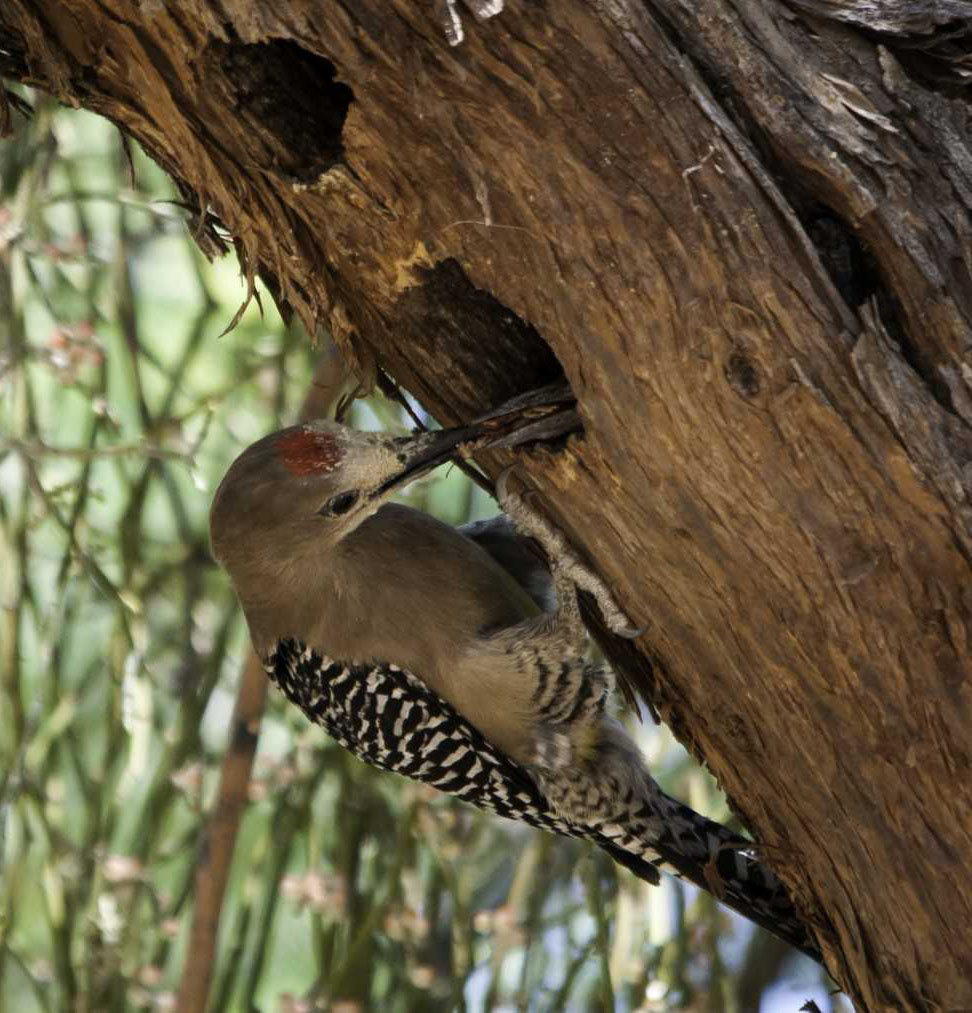
Gila woodpecker father feeds chick in a mesquite tree. (PHOTO: Peggy Coleman)

You should hear them amp up the sound when the feeder is empty! In summer and early fall, when the Lesser long-nosed bats drink from those same feeders every night until there is not a drop, the woodpeckers serve as my morning wake-up call.
Yet, unlike the resident Anna’s hummingbirds that share the feeder, hover around me, poke me, sometimes even follow me into the house when I carry the feeder in for a refill, the Gilas are always wary. Seeing me through the window, as I rise to attend to them, sends them fleeing, but they quickly return.
To me, woodpeckers are marvels of anatomical engineering.
Gila woodpeckers weigh about 3.5 ounces—the same as a deck of cards—and are 8-10 inches long. They have two toes pointing forward and two pointing backward that help them move on vertical surfaces, and very stiff tail feathers that they can press into even prickly cactus spines to help stabilize while whacking away.
Their sturdy beaks come to a gradual point, and are self-sharpening. They have as much chance of fitting into those hummingbird feeder holes as a camel does through the eye of a needle. When I first watched the woodpeckers stand on the feeder, tipping it with their weight as they pressed the end of the beak to the hole, I thought they were sloshing the liquid, so they could get a taste. I was wrong.
gila woodpecker tasting octopus agave unsized body image
A Gila woodpecker samples octopus agave blossoms. (PHOTO: Doris Evans)

What they do have in common with hummingbirds, are tongues so long that they wrap around their skulls. A woodpecker’s tongue is sticky and barbed at the end. It is guided by the flexible, muscle-covered hyoid bone that is attached at the right nostril, dividing into two parts between the eyes, wrapping all the way up and around the back of the skull. There, the separate pieces rejoin and attach to the muscle of the tongue. When the muscles surrounding the relaxed hyoid bone contract, they propel the tongue forward and out of the beak.
These birds bang on surfaces at an average of 12,000 times a day,15 miles per hour. The hyoid bone acts as a seatbelt for the bird’s brain, stabilizing the head and spine, protecting it from neurological trauma.
Woodpeckers’ brains are also tightly seated in their skulls—much more so than human brains, which can slosh on impact.
The upper beak is longer, so it absorbs more of the shock than the lower beak. The force travels up the beak, meeting the hyoid bone in the nostril, before hitting spongy bone in the skull. The stress then travels along the path of the hyoid bone, diffusing into the muscles that cover it.
gila woodpecker feeding young unsized body image
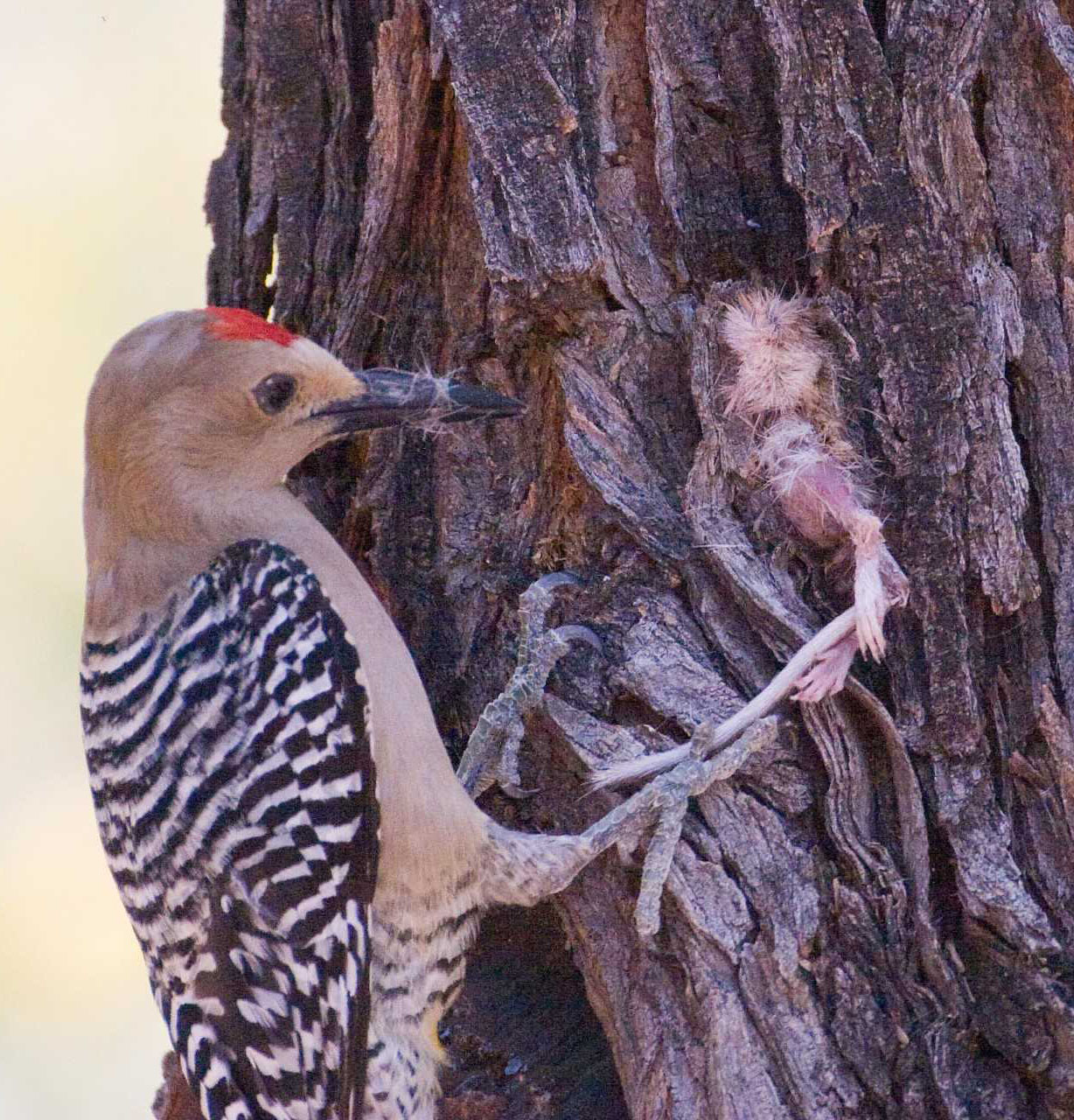
An omnivorous Gila woodpecker feeds its young a piece of a packrat. (PHOTO: Doris Evans)
 
Woodpeckers, who are omnivorous, glean insects from the surface of the bark. Their hearing is so astute, they can detect insect activity well below that, which may explain the added popularity of the rotting mesquite tree where a feeder hangs. The tap-tap-tapping isn’t all about food. On noisily resonant surfaces, such as metal screens and antennas, the birds are announcing their presence and territory.
Gila woodpeckers mate for life—unlike polygamous Acorn woodpeckers. During spring and summer, they are capable of producing two clutches of eggs—three to five each time-- and gestation period is only two weeks.
Both parents take part in nest building and feeding, usually in a mesquite tree or a saguaro cactus, which comes with the bonus of sweet fruit in summer.
gila woodpecker saguaro nest unsized body image
An omnivorous Gila woodpecker feeds its young a piece of a packrat. (PHOTO: Doris Evans) 

The birds perform a kind of surgery when they drill into a cactus to create a nesting site. The plant heals by covering the wound with sap that slowly hardens, forming a solid casing, called a boot. Drying time can take a few months, so holes are excavated, but not used until the next brood. And other birds, lizards, snakes, or rodents may move into these time-share condos.
Gila woodpecker families are around my house daily, so when I saw a fledgling with its head turned and tucked under fluffed-up feathers, unmoving on the ground under the mesquite tree, I wondered if there was a behavioral pattern I’d missed. The youngster didn’t move when I walked out and sat on a nearby bench, but eventually, it woke up and flew up to a neighbor’s roof. I went back to my drawing table, but an hour later, I saw a few people standing around the bird as it sat on a cement entryway. Something wasn’t right. I put the bird in a carrier, and rode with my neighbor to the Tucson Wildlife Center.
As the engine of her vintage sports car loudly rumbled, on what seemed like an endlessly long trip, I thought about the acuity of the bird’s hearing, and wondered if the reverberations along with the trauma would be too much for this little creature to bear. Despite its built-in protection, the woodpecker died 15 minutes after we arrived, probably due to internal injuries from a window strike.
I returned home to find another fledgling and its parent inspecting my newly planted barrel cactus. While I don’t put out bird seed, when it comes to the critters, I live to serve. For the almost three years I’ve been in Tucson, I’ve been filling the watering holes and keeping the sugar bar open, happily accepting my role as barista to the local wildlife.
One of my rewards, is being able to listen to the Gila woodpeckers talk as they tip the feeders and drink in the sweetness of life.

beth surdut with raven statue unsized
Visual storyteller Beth Surdut invites you to observe, with unbounded curiosity, the wild life that flies, crawls, and skitters along with us in our changing environment. From exotic orchids and poison dart frogs to local hawks and javelinas, Surdut illustrates her experiences with wild and cultivated nature by creating color-saturated silk paintings and detailed drawings accompanied by true stories.
You can find Surdut's drawings - and true stories about spirited wildlife at http://www.bethsurdut.com/critters.html and listeningtoraven.com
Beth Surdut's illustrated work Listening to Raven won the 2013 Tucson Festival of Books Literary Award for Non-Fiction. Elements of her raven clan have appeared in Orion Magazine, flown across the digitally looped Art Billboard Project in Albany, New York and roosted at the New York State Museum in an exhibition of international scientific illustrators.

Thursday, July 30, 2015

Harris'Hawks in the Hood


Harris' Hawks in the 'Hood, the newest installment of my illustrated radio pieces, is online now and airs Friday and Saturday on NPR 89.1 KUAT
https://radio.azpm.org/p/azspotlight/2015/7/30/69208-the-art-of-paying-attention-harris-hawks/

What started as


gradually became
and is currently


Visit http://www.bethsurdut.com/critters.html for more wild nature drawings and stories.