Showing posts with label wildlife art. Show all posts

Saturday, January 13, 2018

The Art of Paying Attention: Gila Woodpecker

Paying Attention: Gila Woodpecker (Click for audio on NPR)
© Beth Surdut, 2018
Welcome to my 24-hour, all you can drink, outdoor bar. In other parts of the country, I served hummingbirds a combination of boiled water and sugar from these red feeders, but when I moved to Tucson, I had some surprise patrons belly up to the bar.
Gila woodpecker claims a cactus fruit, Tucson, AZ--drawing by Beth Surdut

Gila woodpeckers — Latin name, Melanerpes uropygialis — are quite dapper, with black-and-white checkered and barred wings and tail, creamy cafĂ©-au-lait head and body, with a golden tinge on the belly, and distinctive white wing patches that show when they fly. The males sport what looks like a red lipstick streak on their heads. Their voices, clearly heard, even when competing with traffic noise, sound like squeak toys having a party.
Giddy talkers, they announce their arrival at my hummingbird feeders, which they drain almost daily, even after visiting the agave flowers.
The woodpeckers show up multiple times a day, announcing their arrival as they land, yakking as they jump down the bark to the feeder, still vocalizing when they land, and in-between drinks, calling back and forth from neighboring utility poles.
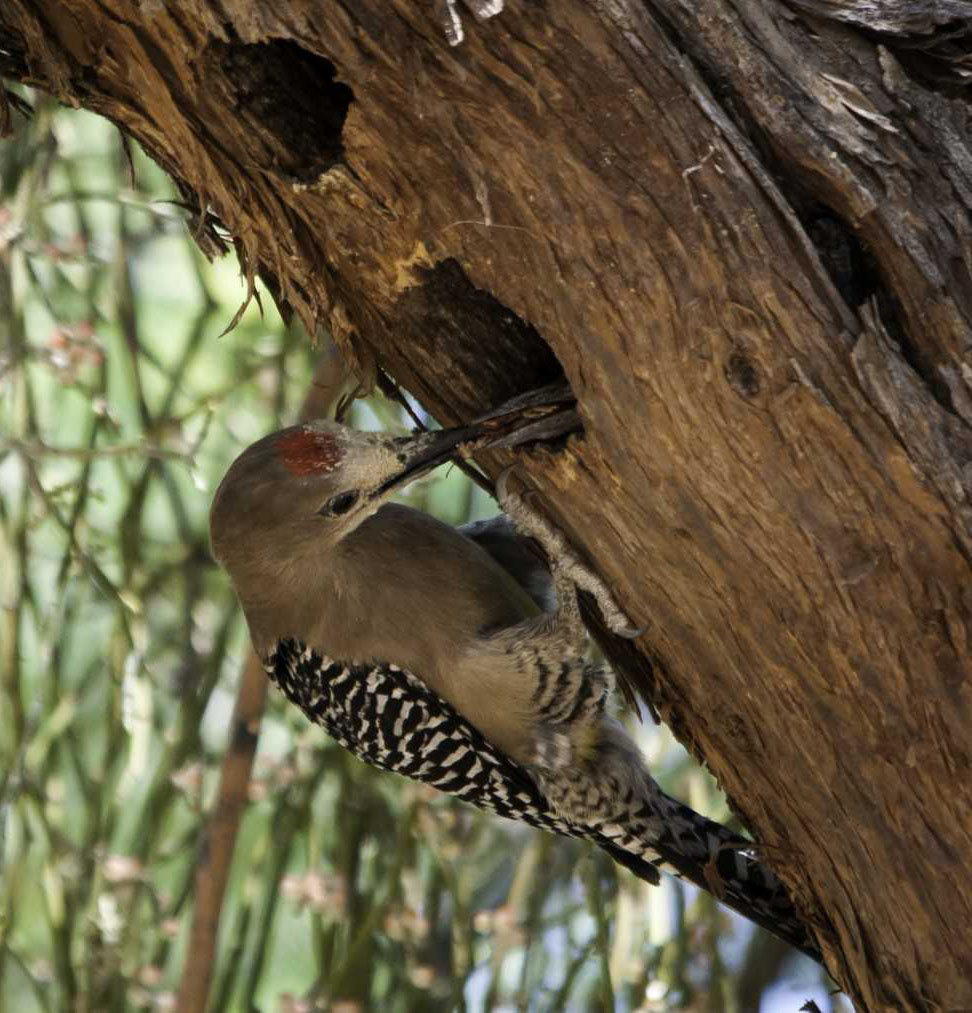
gila woodpecker in mesquite tree unsized body image
Gila woodpecker father feeds chick in a mesquite tree. (PHOTO: Peggy Coleman)

You should hear them amp up the sound when the feeder is empty! In summer and early fall, when the Lesser long-nosed bats drink from those same feeders every night until there is not a drop, the woodpeckers serve as my morning wake-up call.
Yet, unlike the resident Anna’s hummingbirds that share the feeder, hover around me, poke me, sometimes even follow me into the house when I carry the feeder in for a refill, the Gilas are always wary. Seeing me through the window, as I rise to attend to them, sends them fleeing, but they quickly return.
To me, woodpeckers are marvels of anatomical engineering.
Gila woodpeckers weigh about 3.5 ounces—the same as a deck of cards—and are 8-10 inches long. They have two toes pointing forward and two pointing backward that help them move on vertical surfaces, and very stiff tail feathers that they can press into even prickly cactus spines to help stabilize while whacking away.
Their sturdy beaks come to a gradual point, and are self-sharpening. They have as much chance of fitting into those hummingbird feeder holes as a camel does through the eye of a needle. When I first watched the woodpeckers stand on the feeder, tipping it with their weight as they pressed the end of the beak to the hole, I thought they were sloshing the liquid, so they could get a taste. I was wrong.
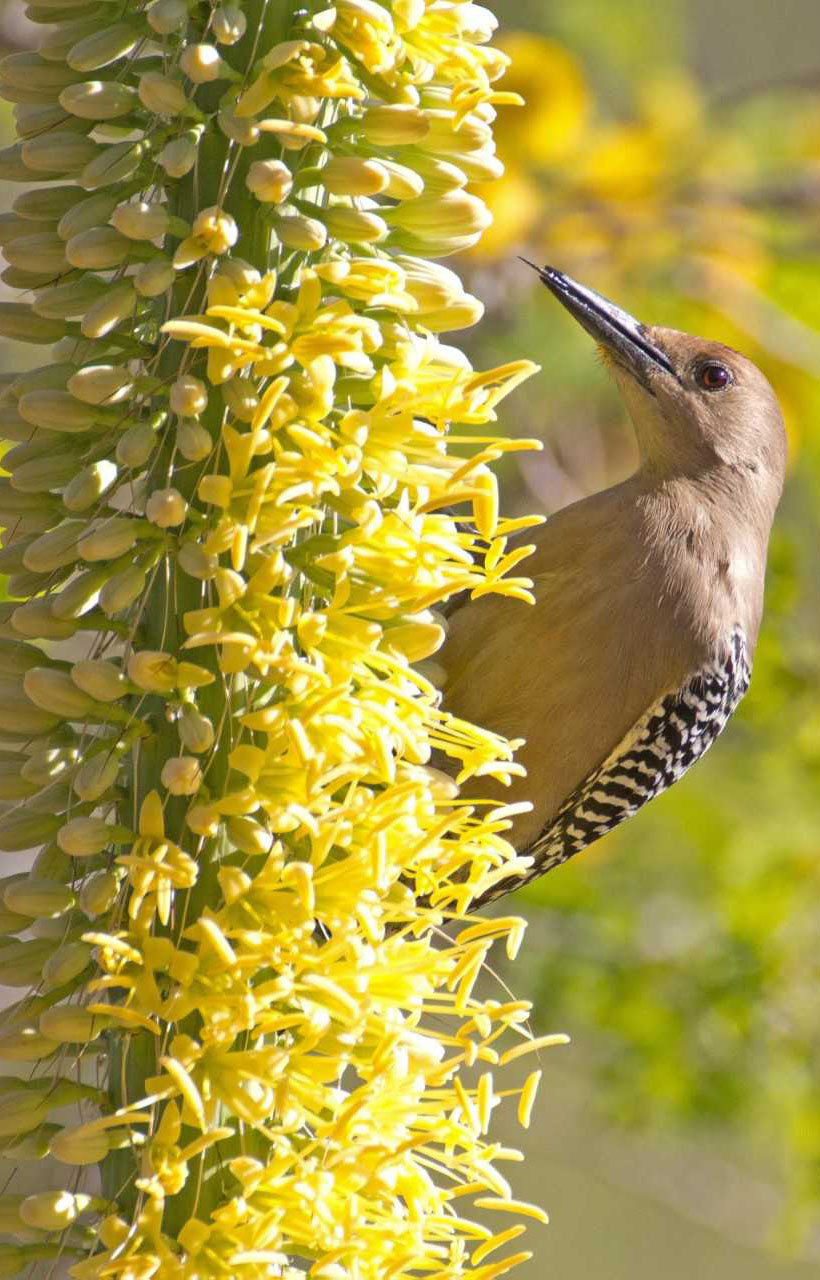
gila woodpecker tasting octopus agave unsized body image
A Gila woodpecker samples octopus agave blossoms. (PHOTO: Doris Evans)

What they do have in common with hummingbirds, are tongues so long that they wrap around their skulls. A woodpecker’s tongue is sticky and barbed at the end. It is guided by the flexible, muscle-covered hyoid bone that is attached at the right nostril, dividing into two parts between the eyes, wrapping all the way up and around the back of the skull. There, the separate pieces rejoin and attach to the muscle of the tongue. When the muscles surrounding the relaxed hyoid bone contract, they propel the tongue forward and out of the beak.
These birds bang on surfaces at an average of 12,000 times a day,15 miles per hour. The hyoid bone acts as a seatbelt for the bird’s brain, stabilizing the head and spine, protecting it from neurological trauma.
Woodpeckers’ brains are also tightly seated in their skulls—much more so than human brains, which can slosh on impact.
The upper beak is longer, so it absorbs more of the shock than the lower beak. The force travels up the beak, meeting the hyoid bone in the nostril, before hitting spongy bone in the skull. The stress then travels along the path of the hyoid bone, diffusing into the muscles that cover it.
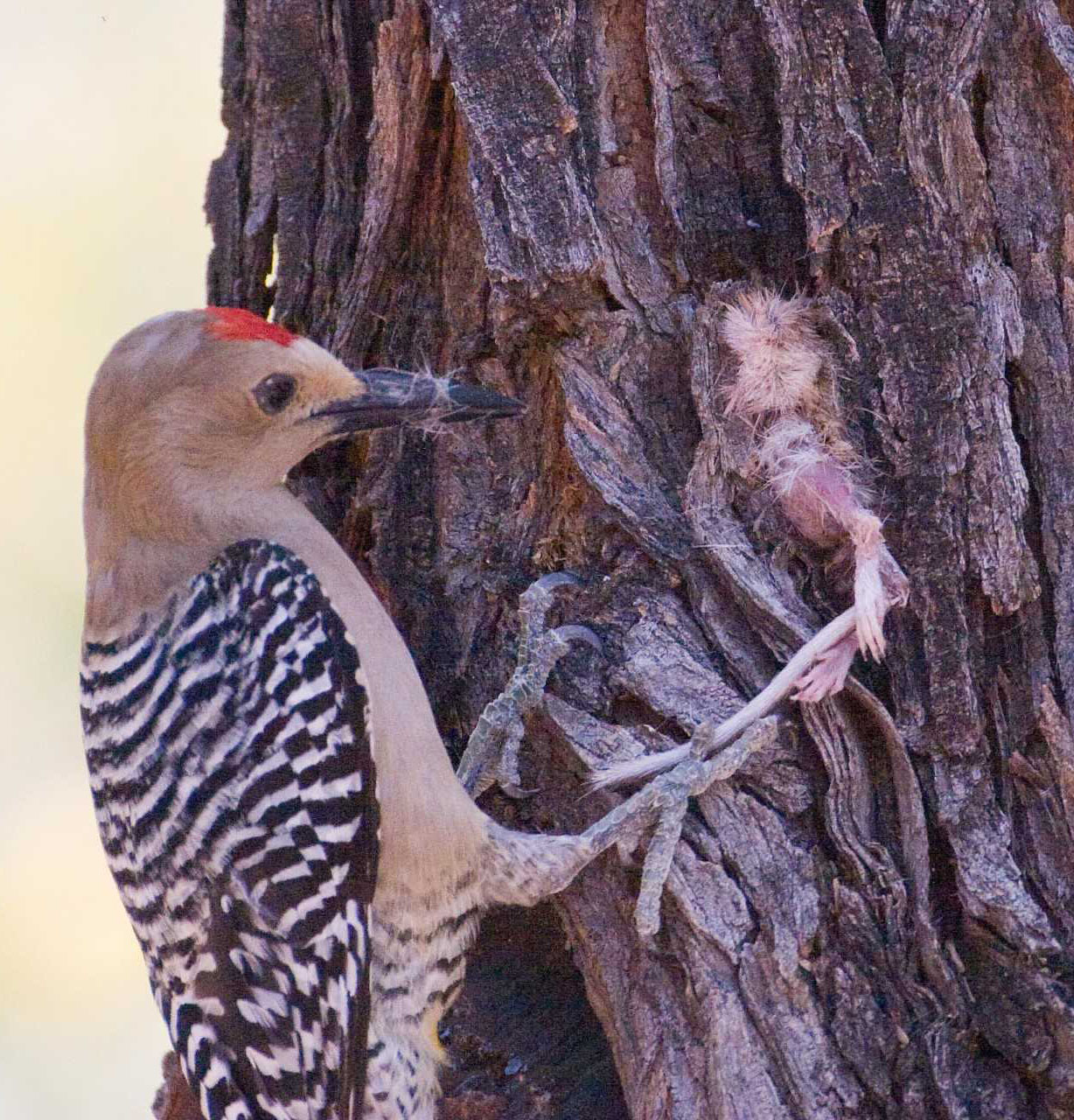
gila woodpecker feeding young unsized body image
An omnivorous Gila woodpecker feeds its young a piece of a packrat. (PHOTO: Doris Evans)
 
Woodpeckers, who are omnivorous, glean insects from the surface of the bark. Their hearing is so astute, they can detect insect activity well below that, which may explain the added popularity of the rotting mesquite tree where a feeder hangs. The tap-tap-tapping isn’t all about food. On noisily resonant surfaces, such as metal screens and antennas, the birds are announcing their presence and territory.
Gila woodpeckers mate for life—unlike polygamous Acorn woodpeckers. During spring and summer, they are capable of producing two clutches of eggs—three to five each time-- and gestation period is only two weeks.
Both parents take part in nest building and feeding, usually in a mesquite tree or a saguaro cactus, which comes with the bonus of sweet fruit in summer.
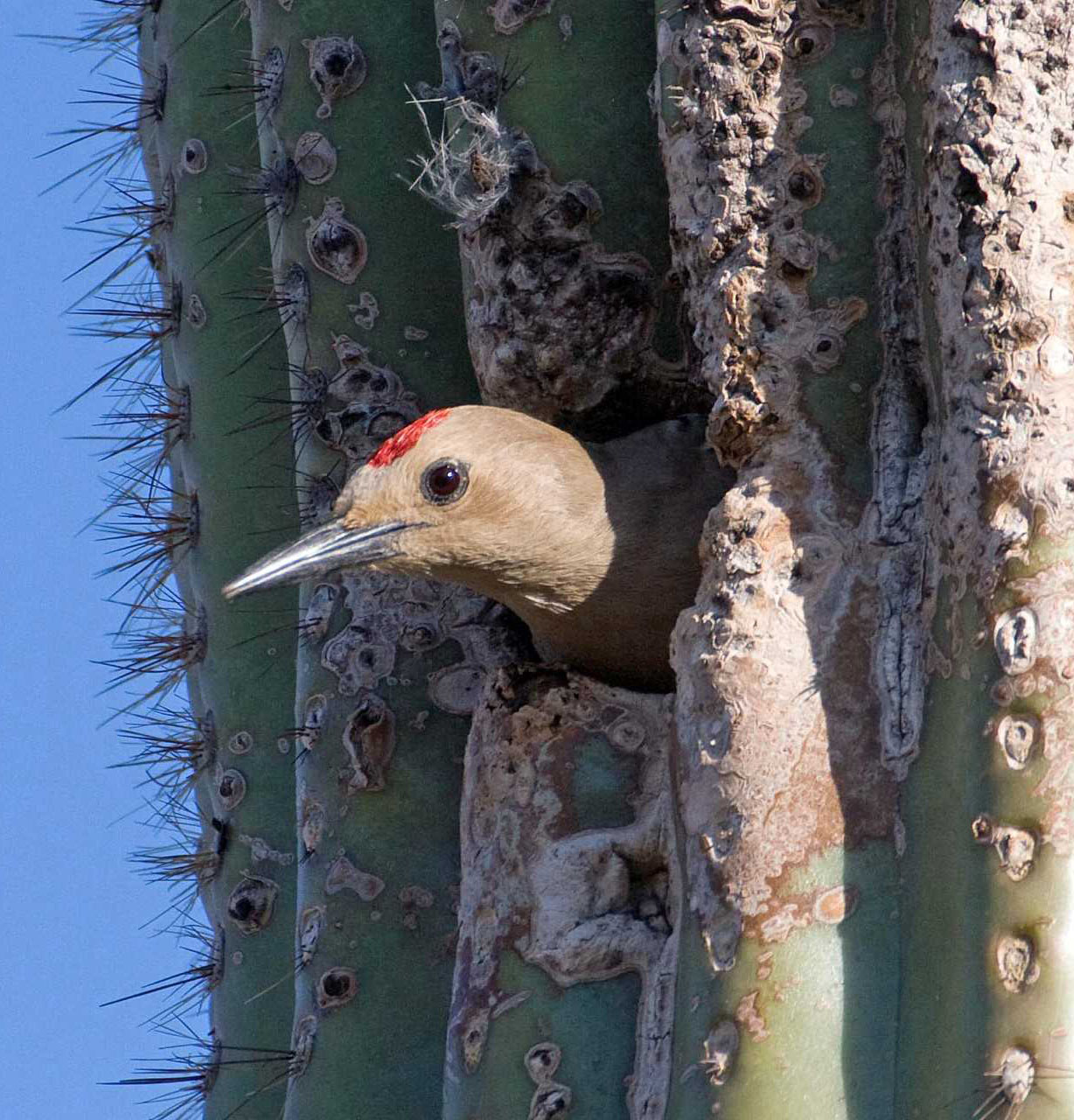
gila woodpecker saguaro nest unsized body image
An omnivorous Gila woodpecker feeds its young a piece of a packrat. (PHOTO: Doris Evans) 

The birds perform a kind of surgery when they drill into a cactus to create a nesting site. The plant heals by covering the wound with sap that slowly hardens, forming a solid casing, called a boot. Drying time can take a few months, so holes are excavated, but not used until the next brood. And other birds, lizards, snakes, or rodents may move into these time-share condos.
Gila woodpecker families are around my house daily, so when I saw a fledgling with its head turned and tucked under fluffed-up feathers, unmoving on the ground under the mesquite tree, I wondered if there was a behavioral pattern I’d missed. The youngster didn’t move when I walked out and sat on a nearby bench, but eventually, it woke up and flew up to a neighbor’s roof. I went back to my drawing table, but an hour later, I saw a few people standing around the bird as it sat on a cement entryway. Something wasn’t right. I put the bird in a carrier, and rode with my neighbor to the Tucson Wildlife Center.
As the engine of her vintage sports car loudly rumbled, on what seemed like an endlessly long trip, I thought about the acuity of the bird’s hearing, and wondered if the reverberations along with the trauma would be too much for this little creature to bear. Despite its built-in protection, the woodpecker died 15 minutes after we arrived, probably due to internal injuries from a window strike.
I returned home to find another fledgling and its parent inspecting my newly planted barrel cactus. While I don’t put out bird seed, when it comes to the critters, I live to serve. For the almost three years I’ve been in Tucson, I’ve been filling the watering holes and keeping the sugar bar open, happily accepting my role as barista to the local wildlife.
One of my rewards, is being able to listen to the Gila woodpeckers talk as they tip the feeders and drink in the sweetness of life.
beth surdut with raven statue unsized
Visual storyteller Beth Surdut invites you to observe, with unbounded curiosity, the wild life that flies, crawls, and skitters along with us in our changing environment. From exotic orchids and poison dart frogs to local hawks and javelinas, Surdut illustrates her experiences with wild and cultivated nature by creating color-saturated silk paintings and detailed drawings accompanied by true stories.
You can find Surdut's drawings - and true stories about spirited wildlife at http://www.bethsurdut.com/critters.html and listeningtoraven.com
Beth Surdut's illustrated work Listening to Raven won the 2013 Tucson Festival of Books Literary Award for Non-Fiction. Elements of her raven clan have appeared in Orion Magazine, flown across the digitally looped Art Billboard Project in Albany, New York and roosted at the New York State Museum in an exhibition of international scientific illustrators.

Wednesday, November 5, 2014

The Nature of Being

Everyone Wants You When You're Beautiful by Beth Surdut
Enigmatic Paradise series  @http://www.bethsurdut.com/gallery-.html
Being in nature is a succession of moments that imprint all my senses. Every walk, every paddle, every buzz, rustle, call, chirp, and squeak informs my creativity as an artist and writer. Just as we take in and process information differently, so do my experiences translate differently even within my own brain and subsequent output.

The part of me that loves detail--knowing the exact conformation and coloration of feather and petal, genus and species--picks up pencils and pens to render what qualifies as scientific illustration. 

Another part of me reacts to color viscerally, judges art on its “edible” appeal, meaning that my first and strongest impression of colors is that they are so juicy I want to lick them no matter what they represent.
There are places—a moss-covered forest trail, a dappled stream, a shadowed slot canyon, an expansive night sky-- that invite me to walk in and lose my edges until they shimmer as I become part of them. There is art that does the same. 
The subtlety of gators--Dragon Scales and Hurricanes series by Beth Surdut @http://www.bethsurdut.com/gallery-.html
            What does this say about being outside in nature? My essence is re-colored by each experience. We are already truly integrated if we permit ourselves to pay attention and experience it. Sometimes that means putting down the canvas, the camera, the journal so we can just Be Here Now. I have read that some athletes who wear a tiny video camera are mortified when they forget to turn it on, that not having digital proof of the bighorn sheep negates the actual experience of having seen them.
 I am not only an observer, but also a kind of chemical experiment, a magnet or perhaps a portal that, when exposed to natural beings and surroundings, takes in elements that reorganize and morph into something both new and familiar in the forms I produce.
I contend that
  • Art is not the “other”
  • Outside is not the other
  • We are not the other
  • We are vital, integrated, shining particles of this world
Breathe in the breath of the world and then see what you breathe out.
I have the good luck to be able to express verbally and visually what swirls and glimmers in and out of me. I am there to see with my eyes, my mind, my memory, not somebody else’s. What comes of experiencing nature betters me more than any indoor classroom situation. I am embraced and expanded by the particulars. And as a wildlife illustrator, storyteller, painter, and maker of prayer shawls,  I get to share that with you. 
"Where shall wisdom be found, and where is the place of understanding?" Job 28:12
 painted silk tallit by Beth Surdut


Friday, October 4, 2013

Raven: The Reason Why

Raven appears as trickster and bringer of magic in stories that fly through time and territory, his cleverness ultimately providing humans with surprising benefits.  
The Reason Why raven appears in The encyclopedia of Santa Fe and Northern New Mexico
 Enduring creatures, Ravens appear in the Lascaux cave paintings, the Bible, Babylonian flood myths, Norse, Celtic, and Native American stories and more. Raucous, rowdy, defiant, sensual and smart, their cleverness is admired by scientists, their mystery acknowledged throughout world cultures.
A jewelry maker from Boston, graduate of the esteemed North Bennet Street School, gave a print of this Raven to a dear friend in New Mexico who knew the pleasure of sitting with her dog named Bear and talking to ravens. Soon after the dog died, a raven feather appeared on the front stoop. The owner believes that the feather is a message from Bear.
Meet more ravens for sale @http://www.bethsurdut.com/listening-to-raven.html

Tuesday, April 19, 2011

Calling peacocks


Power without Sacrifice--silk cape by Beth Surdut

"There are baby peacocks loose in your neighborhood," the head of the Conservation Commission called to tell me. In a rural quintessential New England town that had seen one murder 33 years before I arrived to work as a reporter, small events masquerade as big news. The murder remains unsolved, but this time, I was prepared.
Ordered through the mail,  the peacock youngsters, too young to achieve brilliant coloration (not that the peahens ever would), weren't supposed to take flight until they'd matured, but like airplane schedules I'd encountered in Indonesia,  they took off when they pleased, especially since the owners had yet to build a covered enclosure. So, with a lot less effort than it took to escape the local penitentiary,  the birds had flown the  coop.
"Look up in the  trees, " the Con Com lady advised me.
Not knowing when a peacock caller would come in handy, I'd bought one for $2 from a jolly man who owned a downstairs shop on Boston's tony Newbury Street. The two reeds, a few inches long, bound together at each end with red twine, emit a piercing unbeautiful sound when you blow through them.
Too Much Beauty  
When I lived in  Florida, where a neighborhood was  known for its  free roaming  peacocks, a group of residents lobbied for an ordinance to rid the neighborhood of  these strikingly gorgeous birds with the voices of harridans.
For two years I worked for a newspaper that covered this lovely town of 5,000 people west of Boston complete with apple orchards, a village green, churches, livestock, dogs, cats and wild things-- fierce Fisher cats that howled like banshees,  hungry foxes, and bold coyotes that trotted by clenching little squealing bodies in their jaws.
"What about the cats and dogs," I asked the old woman who showed me the 150 year old house, a former commune with a hand- built Swedish sauna perched by the pond spillway.
"Guess they run a lot faster than they used to," she said grimly.
A neighbor came by to tell me he'd seen a Fisher cat in my yard early one morning. "Cat" sounded like a big kitty. I had no idea what hellishness roamed the forests until another neighbor brought me to the rotting corpse of this fearsome beast from the wolverine family.
I'd seen a determined fox take a gosling from my pond, a hawk snatch a sparrow in mid- air right in front of me, found baby deer legs behind my house. My two inquisitive Khaki Campbell ducks no longer knocked on my front door with their beaks
I now wandered the back roads of what felt like an H.P. Lovecraft horror story, honking my peacock caller, hoping that I would be triumphant.
Nothing.
As light filtered through the trees at day's end, I returned home to find a message from the Con Com lady scribbled on paper and tucked in my screen  door.
Peacocks returned of their own accord.
I have yet to have another chance to try out the efficacy of my peacock caller, but you just never know when it'll come in handy.

Friday, June 25, 2010

Ravens Roost


Truth and Memory
and
Walks Like a Man
may be the current top two favorites so far, with The Compass of My Heart an active Contender, but this swaggering guy is the one who's been going home with people. I love the stories you are bringing to these characters--bird tales, spiritual experiences, intolerant neighbors and macho husbands!
See you at the solo exhibit opening July 9, 2010 at the Randall Davey Audubon Center in Santa Fe!

Saturday, May 23, 2009

The Egg Thief

As I was drawing in the highlights on a pair of raven feet, Raven flew directly towards my studio window, then veered to land in a big pine tree. My pleasure at his arrival turned to foreboding as he placed one foot in front of the other, moving purposefully through the branches towards a songbird's nest that I knew held three eggs.
I ran into the garden, squawking and flapping my arms. Raven glared at me and took off before he reached the nest.

Two days later, I climbed a ladder to find only one egg in the nest. As I grieved, telling myself that this was nature's order, the egg moved! The remaining baby had pecked out much of the underside of the shell.

As I came down the ladder, hoping the mother would return, I saw a tiny yellow beak wobbling open-mouthed in a soft bed of leaves at the base of the tree. Another survivor! I placed it, pink skinned with random patches of gray fuzz, back in the nest.

Raven must have made off with the third egg, for there was no sign at all.

In two more days, the birds have doubled in size, but these babies may still be doomed. My friend David had five little birdkins snatched all at once and he's still moping like a grandfather denied visitation.

And I, recognizing that humans steal and eat eggs from nests every day, I have lost my desire to eat eggs.

This original drawing is pen, pencil, heart and mind on paper size 15" x 21"

Raven brought this mermaid to the high desert. To begin, start with Drawing Raven.

Monday, May 11, 2009

Heartbeat of the earth


At the San Felipe Corn Dance, my pulse thrums with ancient chants as 1500 people dance the heartbeat of the land. It is by their grace that I am here.
Hours later, with Raven by my side, I look for spirit carvings amidst the traditional regalia of whole fox pelts and skunk anklets. Frowning and smiling like a god with two faces, a Zuni fetish seller says, "No, I don't have ravens, they are not good signs for us."
"Don't listen to him, " Raven hisses in my ear. "Be polite, then walk away." So I do.
"Tell our stories," says Raven as he perches on my shoulder, each pinpoint of his claws reminding me of the path I am meant to be taking.

Knowing Raven ( on 10" x 13" paper) is drawn with pen, pencil, heart and mind, as are the other denizens of the Listening To Raven series.
As to raven and carved Zuni fetishes---my first little raven, black marble with turquoise eyes, perches on my work table atop a lapis heart. Both were gifts from dear friends in Santa Fe. While creating Truth and Memory, a carved pair of ravens bound together with turquoise and coral sat watching on the paper's edge. All three were discovered at Keshi in Santa Fe.
The story of why this mermaid came to live in the high desert begins with Drawing Raven.